

Personal Trainer Fees Per Hour: The Quick 2026 Answer
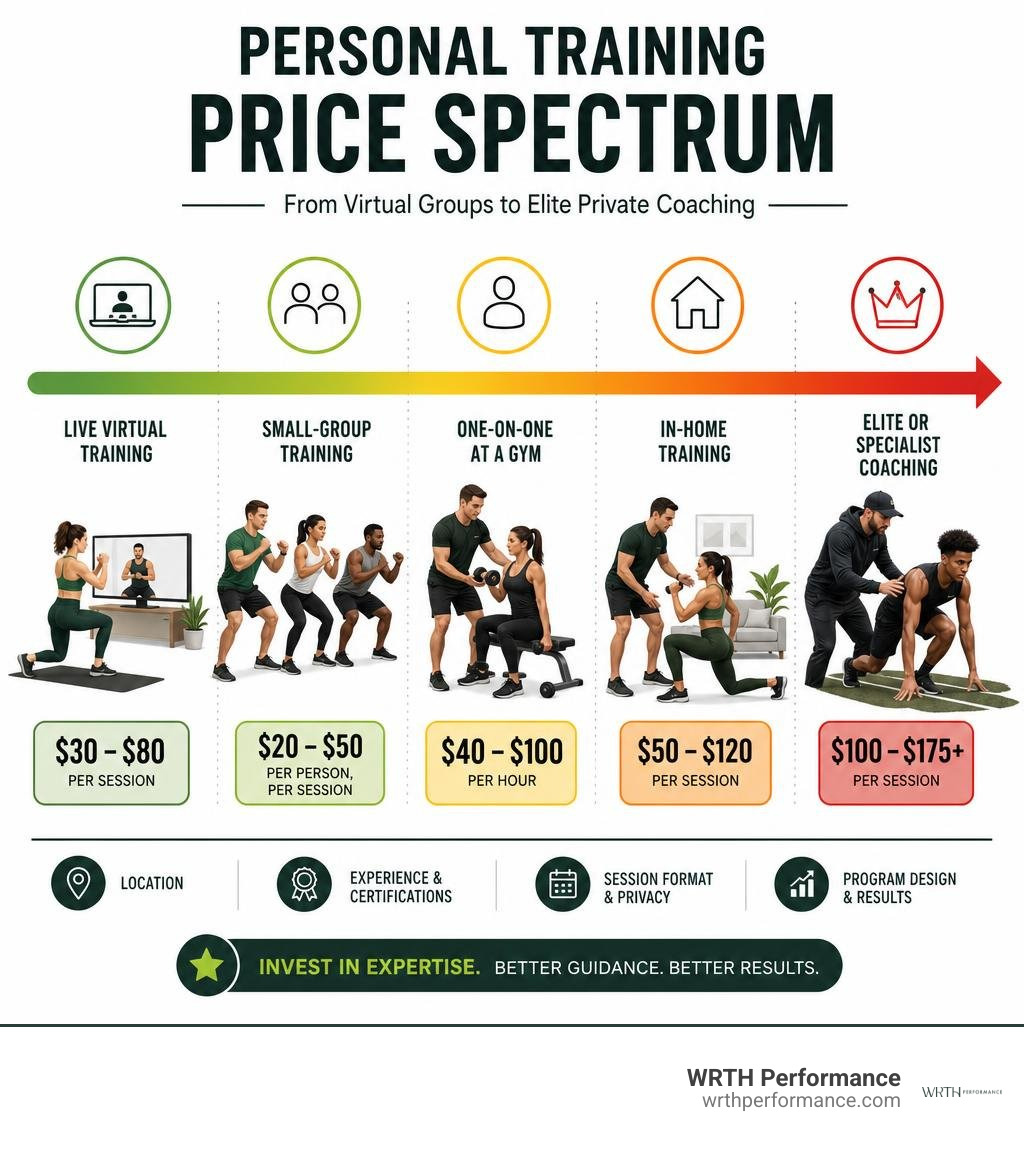
Personal trainer fees per hour typically range from $40 to $100 in the U.S., with a national average around $65 per session. Budget options may start around $35 to $40, while experienced specialists, private studios, in-home training, and major-city coaches can charge $100 to $175 or more.
| Training option | Typical 2026 cost |
|---|---|
| One-on-one training at a gym | $40-$100 per hour |
| Small-group training | $20-$50 per person, per session |
| Live virtual training | $30-$80 per session |
| In-home training | $50-$120 per session |
| Elite or specialist coaching | $100-$175+ per session |
The number on the price list is only part of the story. Location, coaching experience, certifications, session format, privacy, travel time, and the level of program design all affect what you pay – and what you receive.
I am Jason Kasheta, a personal trainer in Orlando with 20 years of experience in strength, fitness, and nutrition coaching. Through Kasheta BodyFit and WRTH Performance, I have helped more than 1,000 people pursue better performance and results, giving me a practical view of what personal trainer fees per hour should include.
Average Hourly Rates for Personal Trainers Across the US
Understanding standard rates across the country provides a solid starting point when setting your fitness budget. Across the United States, average personal trainer fees per hour sit between $55 and $65 per hour for standard one-on-one coaching at standard commercial fitness facilities. However, when looking closely at overall industry statistics, client session rates range from $40 on the lower end to well over $100 per hour on the higher end.
According to data from the Bureau of Labor Statistics, the median hourly wage for fitness trainers nationwide sits at $22.20 per hour, with total annual earnings averaging around $46,180. If you wonder why there is a gap between the $22.20 hourly wage a trainer earns and the $65 hourly fee a client pays, the answer lies in facility overhead, administrative costs, and equipment upkeep retained by commercial gym operators. Certified personal trainers holding credentials from accredited bodies average around $32 per hour in earnings, while independent trainers command $61 to $70+ per hour for one-on-one coaching directly.
For reliable background pricing data on training standard rates, checking out 2026 Personal Trainer Cost Benchmarks gives a clear overview of overall ranges. At WRTH Performance, we prioritize comprehensive coaching value through fully customized programming, dedicated strength work, and full wellness access via our Personal Training Services.
Geographic Location Impact on Rates
Where you live heavily dictates what you will pay per hour for a fitness professional. Geographic pricing variations stem directly from local cost-of-living metrics, commercial real estate lease rates, and community demand for dedicated personal coaching.
Across Florida and the broader Sunbelt region, personal training rates closely track or sit slightly above national averages. In suburban and mid-sized metropolitan areas throughout Florida, single personal training sessions generally fall between $50 and $90 per hour. In booming urban hubs like Downtown Orlando, higher facility costs and a density of busy professionals drive rates for premium coaching up to $75-$150+ per session. By contrast, rural or smaller regional markets routinely feature hourly fees in the $40 to $60 range.

Key Factors That Impact Personal Trainer Fees Per Hour

When evaluating personal trainer fees per hour, it becomes clear that no two training programs are created equal. Several primary drivers determine why one coach charges $45 an hour while another commands $120 an hour in the same city.
- Experience and Track Record: Trainers with years of practical coaching experience charge higher rates because they deliver results faster, reduce movement inefficiencies, and adapt workouts seamlessly on the fly.
- Education and Accredited Certifications: Trainers holding accredited certifications from organizations like NASM, NSCA, ACE, or CSCS have invested significantly in formal exercise science education, movement mechanics, and program design.
- Specialization and Advanced Skills: Coaches specializing in athletic performance development, longevity protocols, functional strength, or nutritional coaching naturally command a premium over general fitness instructors.
- Facility Type and Environment: Training at a busy, crowded commercial gym costs less per hour than training in a private boutique club that caps membership, maintains high-end equipment, and provides modern recovery amenities.
- Session Length: Standard sessions run 60 minutes, but many trainers offer 30-minute or 45-minute options. A 30-minute session may be priced at 60% to 70% of the full hourly rate.
To calculate how these variables combine to form total costs, try using a tool like the Personal Trainer Cost Calculator.
Beginner Personal Trainer Fees Per Hour
Newer trainers who are within their first year or two of coaching generally set their personal trainer fees per hour between $40 and $60 per session. Entry-level coaches often work inside commercial gym chains where they gain client volume, refine their instruction cues, and build their portfolio of real-world results.
While working with a newer trainer can be an economical entry point into structured exercise, clients should expect basic exercise execution rather than deeply customized long-term programming. As beginner trainers accumulate client success stories, secure advanced credentials, and expand their client waitlists, their hourly rates naturally transition upward toward mid-tier market standards ($65–$90/hour).
Elite and Specialist Personal Trainer Fees Per Hour
At the top end of the market, elite personal trainers and performance specialists charge anywhere from $100 to $175+ per hour. These experienced coaches do far more than guide you through a basic workout routine. They conduct complete biomechanical assessments, design personalized training cycles, provide real-time performance adjustments, and integrate recovery strategies into your weekly schedule.
In specialized settings like luxury private clubs or dedicated performance facilities, high-end personal training often incorporates advanced training modalities alongside contrast therapy, infrared sauna access, and nutritional guidance. Clients paying premium hourly fees are investing in efficient time management, complete privacy, top-tier equipment, and high accountability.
Gym-Employed vs. Independent Fitness Trainers
One of the largest factors behind personal trainer pricing models is whether the coach is employed directly by a commercial gym facility or operates as an independent business owner.
Commercial gym chains hire personal trainers as staff employees. The facility handles marketing, sales, client acquisition, and facility upkeep, while charging clients $50 to $90 per session. However, the gym retains 50% to 70% of that hourly fee to cover overhead, leaving the employed trainer with a base pay of $20 to $40 per session. While this model keeps drop-in session costs moderate for gym members, trainer turnover at commercial chains tends to be high as experienced coaches transition into independent practice.
Independent personal trainers operate their own coaching businesses, setting their own session rates and keeping 100% of their earned revenue (minus their business overhead, liability insurance, software fees, and floor rental fees). Independent rates typically sit between $65 and $120+ per hour. Independent coaches are deeply invested in long-term client retention, offer higher customization, and usually provide significantly better client communication outside of workout hours.
For insights on finding dedicated private coaches who focus on long-term client results, read our guide on Finding the Perfect Private Personal Trainer.
Comparing Training Formats and Pricing
The format of your training session plays a major role in your overall out-of-pocket hourly cost. Modern fitness delivery ranges from traditional one-on-one sessions to semi-private groups and virtual coaching apps.
| Training Format | Typical Hourly Cost Range | Best Suited For | Key Advantages |
|---|---|---|---|
| One-on-One In-Person | $50 – $120+ / hour | All experience levels, specific performance goals | Maximum personal attention, immediate form correction, highly custom |
| Semi-Private (2-4 clients) | $30 – $50 / person / hour | Budget-conscious lifters, friends training together | High coaching quality at lower individual rates, strong camaraderie |
| Small Group (5+ clients) | $20 – $40 / person / hour | General fitness, weight loss, conditioning | Low individual cost, high-energy group dynamics |
| In-Home Mobile Training | $70 – $150+ / hour | Executives, busy parents, high-privacy needs | Zero travel time, ultimate convenience in your space |
| Live Virtual Coaching | $30 – $80 / session | Frequent travelers, remote workouts | Train anywhere, flexible scheduling |
| Monthly App / Hybrid Coaching | $100 – $300 / month | Self-motivated lifters needing programming | Constant communication, flexible workout timing, cost-effective |
Semi-private personal training (where a coach works with 2 to 4 individuals simultaneously) has become an increasingly popular option. It allows the coach to earn a higher total hourly rate while reducing the cost for each individual client by 30% to 50% compared to private one-on-one rates.
Package Deals, Monthly Expenses, and Cost-Saving Strategies
Purchasing single, standalone personal training sessions at drop-in rates is almost always the most expensive way to hire a coach. Most personal trainers and specialized fitness facilities offer structured package deals or recurring monthly memberships that substantially lower the effective per-hour fee.
Other effective ways to reduce your training costs without compromising on coaching quality include:
- Adopting a Hybrid Model: Schedule one in-person session per week for coaching on major compound lifts and form evaluation, supplemented by independent workouts delivered through a coaching app.
- Joining Semi-Private Coaching: Train alongside 1 to 3 workout partners with similar goals to split the trainer’s hourly fee.
- Commiting to Monthly Subscriptions: Many independent trainers and private facilities offer monthly recurring memberships that lock in lower hourly session costs in exchange for a predictable monthly schedule.
For additional practical budgeting advice, explore our comprehensive guide on Finding an In-Person Fitness Trainer Without Going Broke and review standard option structures on our Personal Training Pricing page.
Monthly Personal Training Budgets
When budgeting for personal training, calculating your total monthly investment provides a realistic view of ongoing fitness costs. Monthly expenses depend directly on weekly training frequency:
- 1 Session Per Week: $220 – $320 per month (Ideal for maintenance, form reviews, or self-driven lifters).
- 2 Sessions Per Week: $440 – $640 per month (Great for steady progression, body composition changes, and strength building).
- 3 Sessions Per Week: $650 – $950+ per month (Optimal for rapid progress, athletic development, maximum accountability, and complete hands-on coaching).
By viewing personal training as a recurring monthly investment rather than an ad-hoc expense, clients stay more consistent and achieve measurable health, strength, and body composition outcomes faster.
Frequently Asked Questions About Personal Trainer Rates
What is the national average hourly cost for a personal trainer?
The national average cost for a personal trainer is around $65 per hour for standard one-on-one in-person sessions. Across the overall U.S. market, hourly fees range from $40 at local commercial gyms to $100-$175+ per hour for elite specialists and private boutique facilities.
How do package deals lower the per-hour personal training rate?
Package deals may lower per-hour rates by offering bulk discounts in exchange for an upfront commitment. When you purchase 10, 20, or 30 sessions at once, trainers may discount the per-session fee by 10% to 20%, bringing down individual session costs while guaranteeing consistent training schedules.
Is virtual coaching significantly cheaper than in-person training?
Yes, live virtual personal training sessions generally cost $30 to $80 per session, making them roughly 20% to 40% less expensive than standard in-person one-on-one sessions. Monthly online coaching subscriptions (which supply custom programming and message support without live 1-on-1 video spotting) usually range from $100 to $300 per month.
Conclusion
Understanding personal trainer fees per hour empowers you to make informed decisions about your long-term fitness investment. While hourly rates vary based on experience, location, training format, and facility quality, the true value of hiring a dedicated coach lies in efficient programming, movement safety, consistent accountability, and real performance results.
At WRTH Performance in Downtown Orlando, we offer a luxury private membership environment built for focused training, physical performance, and long-term health optimization. We combine expert personalized training with nutrition coaching and science-backed recovery modalities including infrared sauna therapy, cold plunge therapy, PEMF therapy, and red light therapy. To ensure every member receives personalized attention and full access to equipment without crowding, our membership is intentionally capped.
Ready to invest in your physical health, strength, and athletic capability? Learn more about our private membership environment and schedule a consultation through WRTH Performance Personal Training.
