

How to Search for a Qualified Exercise Trainer Near Me
Finding the right fitness professional begins with narrowing down your local options rather than defaulting to the nearest commercial chain. High-traffic big-box gyms often suffer from overcrowded floors, distracted instructors, and cookie-cutter programming. Focusing on dedicated private studios and boutique training environments in Downtown Orlando allows you to work in focused spaces built specifically for results.
When you look for local coaches, leverage community word-of-mouth alongside curated digital searches. Ask colleagues and friends whose fitness progress you admire where they train. You can explore 5 proven ways to find gym personal training near me to streamline your search and filter out commercial fluff. Look for studios that prioritize private, uninterrupted coaching over crowded floor space.
Evaluating Credentials When Searching for an Exercise Trainer Near Me
Anyone can claim to be a fitness expert online, which makes credential verification a critical step. Qualified coaches have invested in degrees in their field or hold accredited certifications recognized by organizations like the National Commission for Certifying Agencies (NCCA).
Outside of college education, industry credentials include:
- NASM (National Academy of Sports Medicine): Focuses heavily on the Optimum Performance Training (OPT) model, human movement science, corrective exercise, and biomechanics. Prospective coaches often review NASM credential requirements and continuing education to master movement mechanics and post-rehabilitative exercise strategy.
- NSCA (National Strength and Conditioning Association): Renowned for its CSCS (Certified Strength and Conditioning Specialist) credential, considered the gold standard for athletic development and power training.
- ACE (American Council on Exercise): Concentrates on functional fitness, health coaching, and sustainable behavioral change.
- ACSM (American College of Sports Medicine): Bridges exercise physiology with clinical exercise protocols and endurance conditioning.
Every legitimate trainer must maintain current CPR (Cardiopulmonary Resuscitation) and AED (Automated External Defibrillator) certifications. In addition, top-tier coaches continually invest in ongoing education and advanced certifications to stay current on sports science, recovery protocols, and movement mechanics.
Matching Trainer Specializations to Your Fitness Goals
A single training style does not fit every body or ambition. Matching your personal goals to a coach’s specific discipline ensures you achieve optimal results safely.
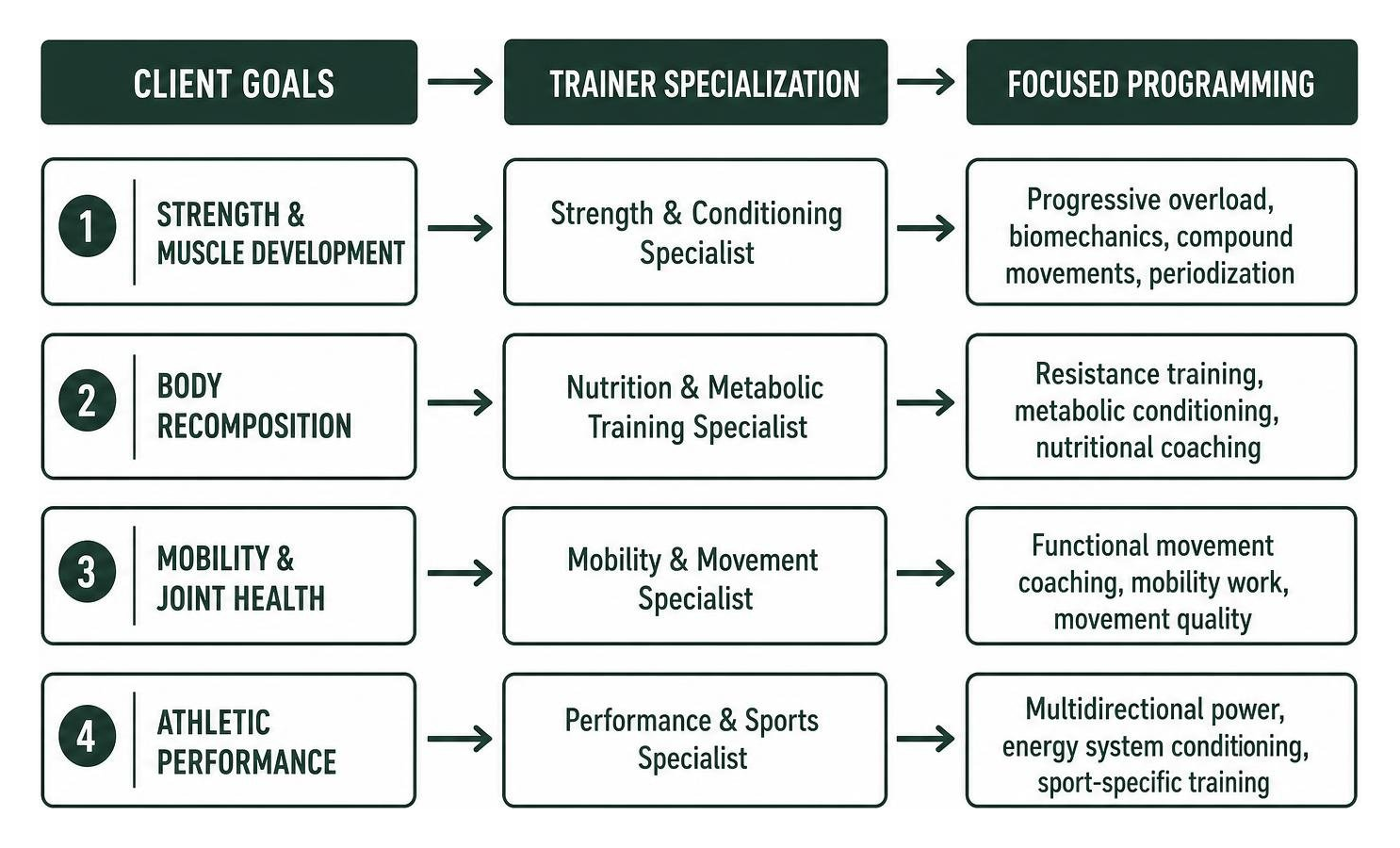
- Strength & Muscle Development: Requires expertise in progressive overload, biomechanics, compound barbell movements, and periodization.
- Body Recomposition: Demands a balanced blend of resistance training, metabolic conditioning, and structured nutritional coaching.
- Mobility & Joint Health: Benefits from specialized coaching in functional movement coaching to improve functional mobility and eliminate movement compensations.
- Athletic Performance: Demands multidirectional power work, energy system conditioning, and sport-specific training.
When you search for an exercise trainer near me, the best match is not always the closest option. A coach who specializes in your specific goal – whether that is building strength, improving mobility, or enhancing athletic performance – will deliver far better results than a generalist who happens to be down the street. Take time to review each trainer’s stated specialties and ask how they have helped clients with similar starting points reach comparable milestones.
How to Vet and Interview Potential Fitness Coaches
Hiring a coach is a major investment in your personal longevity and daily energy. Treat the hiring process like an interview. A reputable coach will gladly participate in a comprehensive consultation to evaluate your movement patterns, discuss your health history, and explain their coaching philosophy.
Key Questions to Ask an Exercise Trainer Near Me Before Hiring
Before committing to a multi-month package, ask direct questions during your initial consultation:
- What accredited certifications and continuing education credentials do you hold?
- How do you assess baseline movement quality and limitations before designing a program?
- What metrics (e.g., strength benchmarks, body composition, mobility assessments) do you track to measure progress?
- How do you customize exercise selection if an old injury flares up?
- What is your cancellation, rescheduling, and membership policy?
A confident, professional fitness coach welcomes these questions and provides clear, evidence-based answers. The consultation is also your opportunity to gauge communication style and coaching personality. You want a trainer who explains the reasoning behind each exercise, listens carefully to your feedback, and adjusts their approach based on how your body responds. A coach who rushes through the consultation or dismisses your questions is unlikely to provide the attentive, individualized guidance you need for long-term success.
Verifying Experience, Client Reviews, and Track Records
Always review a trainer’s history and client outcomes. Look for detailed testimonials from clients who had starting baselines or objectives similar to yours. A seasoned coach should clearly explain how they guided clients through plateaus, rebuilt joint mobility, or helped busy professionals sustain rigorous routines. For clients seeking elite performance standards, exploring high performance personal training illustrates how advanced coaching models translate into everyday vitality.
Beyond testimonials, ask for measurable outcome validation. A qualified coach should be able to share anonymized progress data, such as strength improvements, body composition changes, or mobility gains achieved by previous clients. This evidence-based approach separates coaches who genuinely track results from those who simply count repetitions. Pay attention to how long clients have trained with the coach as well; sustained client relationships often indicate consistent value delivery and a coaching style that supports long-term adherence.
Understanding Training Formats and Pricing Models
Personal training pricing varies based on coach experience, facility exclusivity, and regional location. Across the United States, single session rates generally range from $50 to $120+ per hour. Multi-session packages and monthly full-support coaching provide better long-term value, typically ranging from $300 to $800+ per month depending on session frequency and added services.
| Training Format | Typical Investment | Coach-to-Client Ratio | Best Suited For | Key Advantages |
|---|---|---|---|---|
| 1-on-1 Personal Training | $70 – $150+ / session | 1:1 | Specific athletic goals, technique perfection, custom recovery | 100% customized programming, total form supervision, flexible pacing |
| Semi-Private Coaching | $40 – $75 / session | 1:2 to 1:4 | Budget-conscious individuals wanting customized plans | Small group camaraderie, personalized adjustments, lower cost |
| Small Group / Bootcamp | $20 – $40 / session | 1:6 to 1:15+ | General conditioning, high-energy motivation | Social community, high caloric burn, energetic atmosphere |
For a complete breakdown of what influences local fitness rates, review this transparent breakdown of hourly coaching rates to plan your investment wisely.
One-on-One Personal Training and Customized Coaching
One-on-one personal training offers the highest level of personalization, direct accountability, and exercise efficiency. Every repetition, tempo, and rest period is directly supervised to ensure safety and performance.
To get the most out of individualized sessions, prioritize finding the right private fitness environment where you do not have to wait for equipment or train in chaotic, noisy surroundings. A private setting allows your coach to focus entirely on your movement patterns, recovery indicators, and technique refinements.
Setting Realistic Timelines and Expectations
Sustainable physical transformations require consistency and physiological adaptation. While initial neuromuscular adaptations and energy improvements often occur within the first 7 to 14 days, measurable body composition changes and significant strength gains typically appear within a 4 to 8 week window of consistent training 2 to 4 times per week.
Coupling targeted strength work with customized wellness strategies ensures your nutrition, sleep, and lifestyle support your workouts rather than working against them. Long-term habit formation is the ultimate goal; a skilled coach helps you build sustainable routines that continue delivering results long after your initial training package ends.
Frequently Asked Questions About Hiring a Personal Trainer
What happens during a first personal training consultation?
An initial consultation consists of a comprehensive fitness history review, lifestyle assessment, and functional movement screening. Your coach evaluates your joint mobility, core stability, movement mechanics, and current conditioning baseline before designing your individualized plan. This session also establishes goal alignment and baseline performance testing so both you and your coach have clear reference points for measuring future progress.
How much does a personal trainer cost per session?
Individual session rates typically range from $50 to $120+ depending on the coach’s credentials, geographic region, and facility type. If you are balancing financial considerations with your fitness goals, check out this guide on finding an in-person trainer on a budget to maximize the value of every session.
How many days per week should I work with a trainer?
Most clients achieve optimal results by training with a coach 2 to 4 days per week. This provides adequate training frequency to stimulate muscular adaptation and neurological strength while allowing necessary recovery intervals between demanding workouts. Your coach can also help you integrate independent workouts on non-training days to support progressive overload without overtraining.
Conclusion: Finding the Right Long-Term Training Partner
Transforming your health, strength, and daily energy requires more than an arbitrary routine found on social media. It requires an individualized system built around your movement mechanics, schedule, and lifestyle.
At WRTH Performance in Downtown Orlando, we provide an exclusive private training environment designed for long-term health and athletic longevity. Our capped membership ensures distraction-free coaching paired with advanced recovery modalities – including infrared sauna therapy, cold plunge therapy, PEMF therapy, and red light therapy.
Stop scrolling through endless search results. Experience science-driven coaching and recovery tailored entirely to you by applying for our private Personal Training program or joining our exclusive membership waitlist today.
