
What PEMF Therapy Actually Does – And Why High Performers Are Paying Attention
PEMF therapy – short for Pulsed Electromagnetic Field therapy – is a non-invasive treatment that uses low-frequency electromagnetic pulses to stimulate healing at the cellular level, without any skin contact or needles.
Here’s a quick overview of what it is and what the evidence says:
| Topic | Key Facts |
|---|---|
| What it is | A device emits pulsed electromagnetic fields that penetrate soft tissue and bone |
| How it works | Pulses induce tiny electrical currents in cells, boosting energy production and reducing inflammation |
| Best evidence for | Chronic low back pain, knee osteoarthritis, certain bone fractures, post-surgical pain |
| Typical session | 15–30 minutes daily for acute issues, 2–3x per week for chronic conditions |
| Safety | Generally considered safe – avoid with pacemakers or during pregnancy |
| FDA status | Cleared for specific uses including pain, edema, osteoarthritis, and plantar fasciitis |
The idea is straightforward: your cells run on electrical charge. Stress, injury, and aging can deplete that charge. PEMF essentially acts as a recharge – nudging cells back toward their natural state so they can do their jobs better.
Clinical research backs this up more than most people realize. A systematic review of randomized controlled trials found magnetic field therapies produced pain reductions of approximately 2–3 points on standard pain scales, alongside measurable improvements in physical function for musculoskeletal conditions. A separate meta-analysis confirmed similar benefits specifically for knee osteoarthritis, improving pain, stiffness, and mobility.
It’s not a magic bullet. But for the right conditions, the evidence is solid enough that the FDA has cleared specific PEMF devices for medical use, and Medicare reimburses PEMF for treating chronic wounds.
I’m Jason Kasheta, a personal trainer and performance coach with over 20 years of experience in exercise science and recovery optimization – and PEMF therapy is one of the modern recovery tools I’ve integrated into high-performance programming alongside traditional strength training. In this guide, I’ll break down exactly how it works, what the science actually supports, and how to use it practically.
Understanding Pulsed Electromagnetic Field Technology
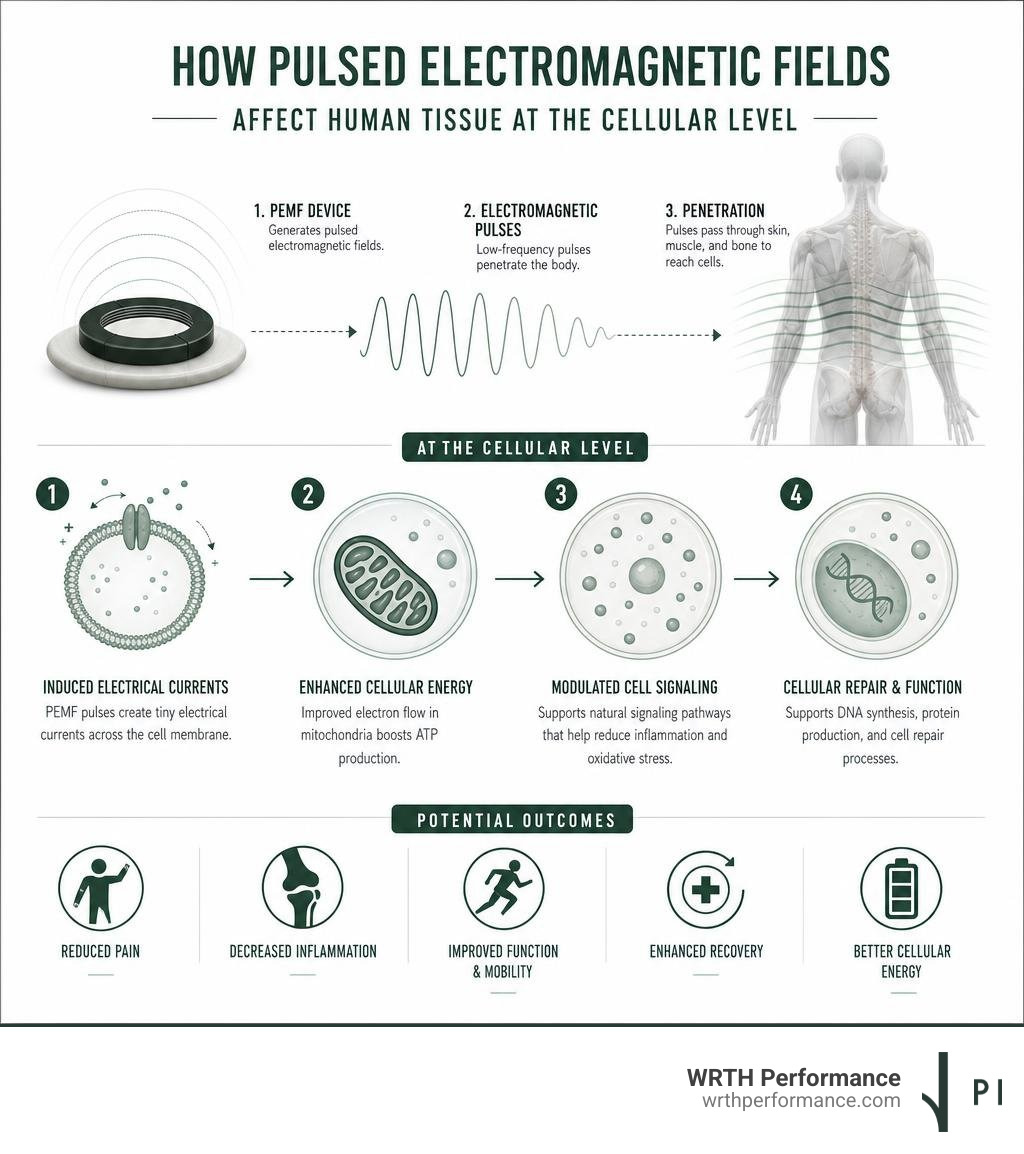
At its core, pemf therapy is about restoring order to cellular chaos. Every single cell in your body behaves like a microscopic, rechargeable battery. To function optimally, these cells must maintain an electrical gradient across their membranes. When tissues are injured, inflamed, or simply exhausted from intense physical training, the electrical potential of these cells drops.
Think of your body after a brutal workout or a stressful week: your cellular “batteries” are drained. PEMF devices act as a wireless charging pad for these cells. By passing a pulsed electromagnetic field through your body, the device induces tiny, safe electrical currents within the tissues. This process helps restore the natural cellular charge, boosting microcirculation, reducing systemic inflammation, and accelerating overall tissue regeneration.
How PEMF Therapy Works at the Cellular Level
To truly appreciate how pulsed electromagnetic fields trigger systemic healing, we have to look closely at the cell membrane.
When a PEMF wave passes through tissue, it alters the cell membrane’s permeability. This change allows calcium ions to flow more freely into the cell, which directly modulates calcium-calmodulin binding. This binding is a crucial biological trigger. It activates specific enzymes known as nitric oxide synthases (specifically eNOS and nNOS), leading to short, controlled bursts of nitric oxide.
Unlike the destructive nitric oxide produced by iNOS during chronic inflammation, these targeted bursts of nitric oxide act as a powerful vasodilator. They relax blood vessels, dramatically improve local blood and lymphatic circulation, and decrease localized swelling.
Furthermore, this biochemical cascade directly influences:
- Transmembrane Potential: PEMF can hyperpolarize cell membranes to around -90mV. This temporary hyperpolarization helps block the transmission of pain signals along peripheral nerves, offering rapid, non-pharmacological pain relief.
- ATP Synthesis: By stimulating the mitochondria (the powerhouses of the cell), PEMF increases the production of Adenosine Triphosphate (ATP), giving cells the energy they need to repair themselves.
- Cell Membrane Permeability and Flexibility: Improved permeability makes it easier for nutrients and oxygen to enter the cell while speeding up the removal of metabolic waste products.
For a deeper dive into these microscopic biological reactions, you can read the PEMF Therapeutics Mechanism Study.
Key Waveforms, Frequencies, and Intensities
Not all electromagnetic fields are created equal. The therapeutic success of pemf therapy depends heavily on three factors: waveform, frequency, and intensity.
Modern clinical and consumer devices generally utilize specific waveforms designed to maximize cellular resonance. The “Triple Sawtooth” wave and the “Square Wave” are widely considered the gold standards in waveform engineering. Because of their rapid rise and fall times, these waveforms deliver a clean, sharp pulse that prevents cells from acclimating to the signal, ensuring maximum biological stimulation.
In terms of frequency, most therapeutic PEMF devices operate in the low-frequency range, typically between 1 Hz and 50 Hz, to mimic the natural electromagnetic rhythms of the Earth (such as the Schumann Resonances). These low frequencies are highly effective for long-term cellular regeneration, relaxation, and chronic pain management.
Intensity, or magnetic flux density, is measured in Gauss or Tesla (where 1 Tesla = 10,000 Gauss). Devices can be broadly categorized into:
- Low-Intensity PEMF: Operating in the microtesla to millitesla range. These are typically used in full-body mats featuring flexible copper fiber coils, designed for systemic recovery, sleep improvement, and mild inflammation reduction.
- High-Intensity Peripheral Magnetic Stimulation (PMS): Reaching up to several Teslas. These clinical devices generate fields strong enough to cause visible muscle contractions and are primarily used for rapid, targeted pain relief and deep neuromuscular re-education.
The Science Behind PEMF Therapy: Clinical Evidence and Efficacy
While the cellular mechanisms are fascinating, does pemf therapy hold up in real-world clinical settings? The short answer is yes. Over the past few decades, researchers have rigorously tested magnetic field therapies across a wide range of orthopedic, neuromuscular, and inflammatory conditions.

Relief for Chronic Pain and Joint Osteoarthritis
One of the most clinically validated applications of PEMF is in the management of joint degeneration and chronic back pain. Osteoarthritis of the knee, for instance, is a leading cause of mobility loss worldwide.
A comprehensive meta-analysis evaluating the effects of magnetic therapies on knee osteoarthritis found that patients receiving active treatment experienced significant improvements in pain, stiffness, and physical function compared to those receiving a sham (placebo) treatment. These improvements were reflected in significantly better Western Ontario and McMaster Universities Osteoarthritis Index (WOMAC) scores.
For those dealing with chronic spinal issues, a randomized double-blind placebo-controlled trial demonstrated that PEMF therapy is highly effective for reducing chronic low back pain. Patients consistently report a 2 to 3-point reduction on the Visual Analog Scale (VAS) for pain, along with significant improvements in their Oswestry Disability Index (ODI) scores. To explore these orthopedic findings in detail, review the Frontiers Systematic Review on Orthopedic Pain.
Bone Healing and Tissue Regeneration
Long before PEMF was popularized in luxury wellness circles, orthopedic surgeons were using it to heal stubborn bone fractures. The FDA first cleared PEMF in the late 1970s specifically for treating non-union fractures/bone breaks that fail to heal on their own over time.
PEMF stimulates osteoblast (bone-building cell) activity and upregulates key growth factors like Bone Morphogenetic Proteins (BMPs). This accelerates the mineralization process, helping bridge the gap in delayed union fractures.
Beyond bones, PEMF is highly effective for soft tissue healing. Clinical data shows that applying PEMF after invasive procedures can speed up recovery. For example, in a study monitoring patients after breast augmentation surgery, the group treated with PEMF experienced pain reduction nearly three times faster than the control group, alongside a significant decrease in postoperative edema.
Neurological Applications and Cognitive Health
Can electromagnetic fields influence the brain and peripheral nervous system? The clinical consensus is a resounding yes. Because nerve cells are highly electrical, they are exceptionally responsive to magnetic stimulation.
High-intensity Peripheral Magnetic Stimulation (PMS) works by depolarizing axons in the peripheral nervous system. This depolarization can bypass damaged pathways, reactivate dormant neural connections, and reduce spasticity in stroke survivors. It has also shown immense promise in treating neuropathic pain, such as diabetic neuropathy, with one study reporting that 66% of diabetic patients became completely pain-free after a dedicated treatment protocol.
To understand the neurological protocols of magnetic stimulation, you can explore the StatPearls Clinical Reference on Peripheral Magnetic Stimulation.
On the cognitive front, cutting-edge research is currently investigating how pulsed fields can combat neurodegenerative diseases. For instance, the EVOKE study – a double-blinded pilot trial involving patients with mild to moderate Alzheimer’s disease – is tracking how targeted PEMF treatment over 120 days affects cognitive decline, utilizing the neuroprotective and anti-inflammatory properties of electromagnetic fields to preserve brain function.
Comparing PEMF to Other Recovery Modalities
At WRTH Performance, we believe in a science-driven, multi-faceted approach to physical longevity. While pemf therapy is an incredible tool, it is most effective when integrated into a broader recovery ecosystem.
Here is how PEMF compares to other advanced wellness modalities:
| Modality | Primary Mechanism | Depth of Penetration | Best For |
|---|---|---|---|
| PEMF Therapy | Induces micro-currents; restores cellular voltage | Deep (passes completely through the body) | Joint pain, bone healing, nerve regeneration, deep systemic inflammation |
| Red Light Therapy | Stimulates mitochondrial cytochrome c oxidase | Superficial to Moderate (up to 2-3 cm) | Skin rejuvenation, muscle soreness, localized blood flow, collagen production |
| Infrared Sauna | Thermal vibration; elevates core body temperature | Moderate (1.5 to 2 inches) | Cardiovascular health, detoxification, deep muscle relaxation |
| Cold Plunge | Vasoconstriction; triggers hormetic stress response | Systemic (nervous system response) | Acute inflammation, central nervous system recovery, mental resilience |
PEMF vs. Red Light Therapy and Thermal Modalities
The main difference between PEMF and light or heat therapies lies in how they interact with your body. Red light therapy relies on photons of light to stimulate the mitochondria in your cells. It is incredibly effective for skin health and surface-level muscle recovery, but light cannot penetrate deep into a hip joint or through thick bone.
PEMF, on the other hand, passes completely through your body. The magnetic field doesn’t stop at the skin; it penetrates deep tissues, organs, and bones unimpeded, making it the superior choice for deep-seated joint issues and systemic cellular recharge.
Rather than choosing just one, the real magic happens when you combine these modalities. For instance, using our PEMF & Red Light Therapy systems in tandem allows you to stimulate superficial mitochondrial activity while simultaneously charging deep joint tissues.
Following up your strength training session with a session in our Infrared Sauna Therapy suite promotes massive vasodilation and sweating, while a subsequent dip in our Cold Plunge Therapy triggers a powerful anti-inflammatory response. Integrating PEMF into this cycle ensures your cells have the electrical energy required to process these thermal stressors and adapt quickly.
Safety, Side Effects, and Practical Protocols
One of the greatest benefits of pemf therapy is its exceptional safety profile. Because it uses low-frequency, non-ionizing electromagnetic fields (unlike harmful X-rays or UV radiation), it does not damage cells or mutate DNA. However, like any therapeutic tool, it must be used responsibly.
Who Should Avoid PEMF Therapy?
While PEMF is safe for the vast majority of people, there are several absolute contraindications:
- Pacemakers and Implanted Electrical Devices: The magnetic pulses can interfere with the electronics of pacemakers, defibrillators, or insulin pumps.
- Pregnancy: Due to a lack of long-term safety studies on developing fetuses, pregnant women should avoid PEMF.
- Active Fungal Infections: Some veterinary and clinical observations suggest that electromagnetic fields can inadvertently support the growth of certain fungal skin lesions. Always clear up fungal infections before applying PEMF directly to the area.
- Ferromagnetic Implants: While modern titanium joint replacements are generally safe, older implants containing magnetic metals may experience slight heating or physical force under high-intensity clinical devices.
Standard Treatment Protocols and Session Durations
For general wellness, cellular maintenance, and athletic recovery, a standard PEMF session lasts between 15 and 30 minutes.
The frequency of your sessions should depend on your specific goals:
- Acute Injuries (e.g., muscle strains, sprains, or post-surgical wounds): Daily sessions for 1 to 2 weeks can dramatically accelerate early-stage tissue repair and control swelling.
- Chronic Conditions (e.g., knee osteoarthritis, chronic low back pain): Sessions 2 to 3 times per week for 4 to 6 weeks are typically recommended to build cumulative benefits and achieve lasting pain relief.
- General Recovery & Longevity: 1 to 2 sessions per week integrated into your regular training routine to keep cellular energy high and reduce systemic inflammation.
Frequently Asked Questions About PEMF
How quickly can I expect to see results from PEMF?
Many individuals experience a noticeable reduction in acute pain and muscle tension after their very first 15 to 30-minute session. However, for chronic conditions like osteoarthritis or bone healing, the benefits are cumulative. Measurable improvements in tissue structure and long-term pain reduction typically manifest over 3 to 4 weeks of consistent use.
Can PEMF therapy be used for pets and animals?
Yes, PEMF is widely used in veterinary medicine, particularly for performance horses and aging dogs. It is highly effective for managing canine osteoarthritis, accelerating bone healing in fractures, and treating intervertebral disc disease (IVDD). Because animals cannot experience a placebo effect, their positive responses to PEMF provide excellent real-world evidence of its physiological efficacy.
Is PEMF therapy safe to use every day?
Yes, low-frequency, low-intensity PEMF is safe for daily use. Because it mimics the natural electromagnetic frequencies of the Earth, daily sessions do not overload the body. Instead, they provide a consistent, gentle boost to cellular metabolism and microcirculation, helping you recover from daily physical stressors.
Conclusion
In an era where high performance is closely linked with physical longevity, we cannot rely solely on traditional training methods. To truly optimize our health, we must look at recovery through a cellular lens. PEMF therapy offers a scientifically validated, non-invasive way to recharge your cellular batteries, reduce chronic pain, and accelerate tissue repair.
At WRTH Performance, a luxury private membership gym in Downtown Orlando, Florida, we intentionally limit our clientele to provide an elite, science-driven training and recovery experience. We believe that true physical longevity requires a balance of intelligent strength training and cutting-edge recovery technology.
By incorporating tools like PEMF into your routine, you aren’t just recovering from your last workout—you are establishing a new standard for your long-term health. To learn more about how we integrate these cellular therapies into our personalized training programs, explore our guide on Longevity: The New Performance Standard or book a session at our WRTH Performance PEMF & Red Light Therapy suite today.
