

Why Personalized Training Programs Deliver Results Generic Plans Can’t
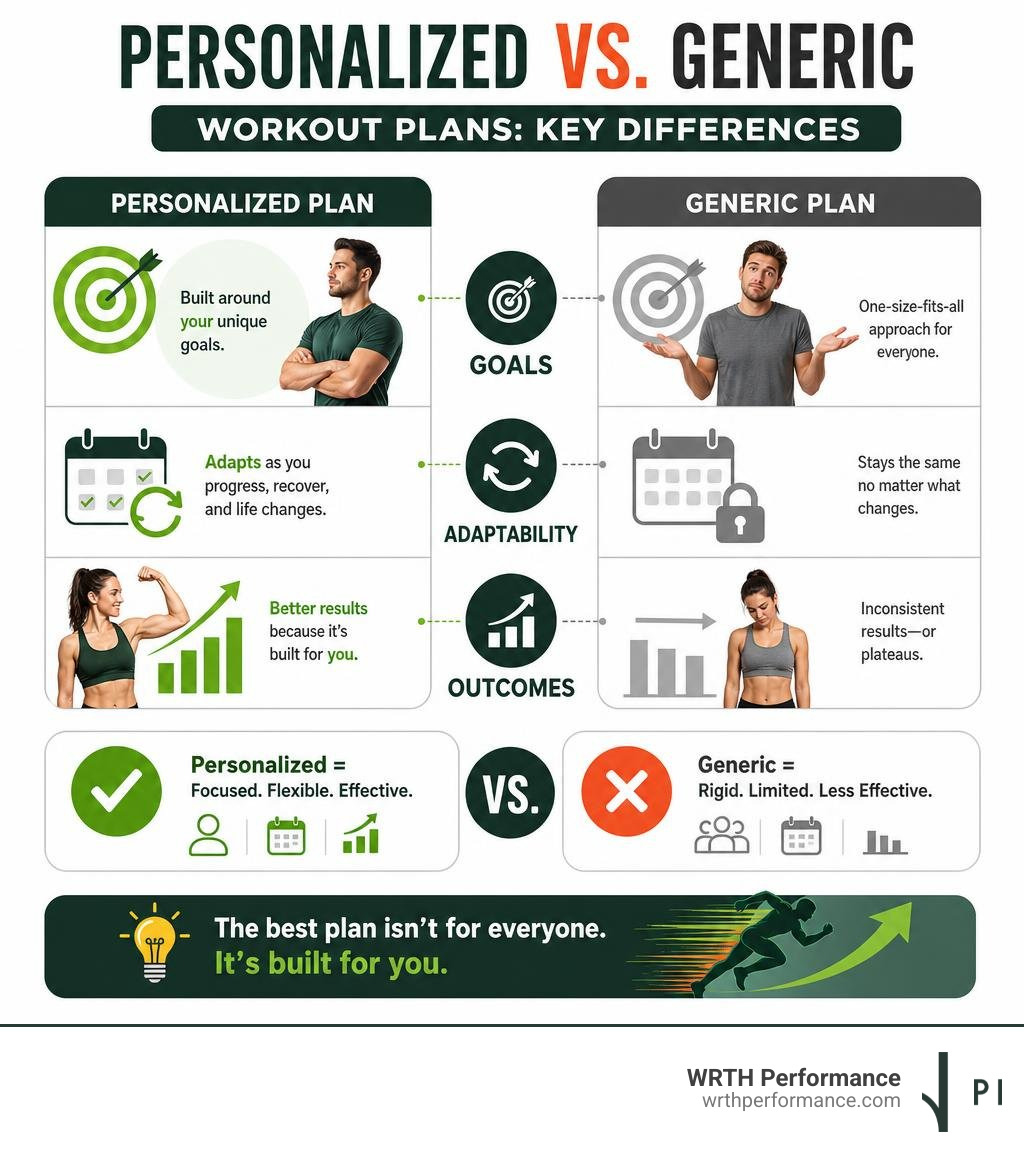
Personalized training programs are structured fitness plans built around your specific goals, body, schedule, and limitations – not a generic template designed for the “average” person.
Here’s what makes them different at a glance:
| Feature | Personalized Program | Generic Plan |
|---|---|---|
| Built for your goals | Yes | No |
| Accounts for injuries | Yes | Rarely |
| Matches your schedule | Yes | No |
| Adapts as you progress | Yes | No |
| Uses your fitness data | Yes | No |
Most people don’t fail because they lack motivation. They fail because the plan they’re following was never built for them.
Generic workout plans assume you have average fitness, average recovery, average time, and average goals. That’s rarely true – especially if you’re a high-performer who expects more from your training.
The data backs this up. Athletes who followed personalized programs showed significantly better results in strength, speed, and agility compared to those on standardized plans. And 78% of home exercisers say they prefer customizable plans tailored to their goals and abilities.
I’m Jason Kasheta, a personal trainer with 20+ years of experience designing personalized training programs for over 1,000 clients – from everyday professionals to NCAA and competitive strength athletes. In this guide, I’ll walk you through exactly how these programs are built, what separates good ones from great ones, and how modern tools like AI are changing the game.
Key personalized training programs vocabulary:
The Science of Personalized Training Programs vs. Generic Plans
When you embark on a fitness journey, the temptation to download a free “one-size-fits-all” template from the internet is strong. However, sports science repeatedly demonstrates that generic plans fail to optimize individual biology. At WRTH Performance, we base our Personal Training philosophy on the fundamental biological law of overload and adaptation.
For any exercise to yield results, it must trigger a stimulus that exceeds your current physical capacity. This is known as progressive overload. However, if the stimulus is too weak, no adaptation occurs; if it is too strong, injury and overtraining follow.
Consider resistance training and muscle growth. Peer-reviewed sports science shows that muscle protein synthesis is elevated by 50% at 4 hours following resistance training and peaks at a whopping 109% at 24 hours post-workout. This window highlights the critical importance of localized recovery. A generic plan might schedule heavy deadlifts and squats on consecutive days, ignoring your individual recovery capabilities and leading to chronic fatigue.
By contrast, personalized training programs are engineered with your exact biological recovery rate in mind. They balance training volume and intensity so that you train a muscle group precisely when muscle protein synthesis is ready for another stimulus. This level of customization is the difference between spinning your wheels and achieving true athletic success.
Key Data and Metrics for Designing a Custom Workout Plan
To build a plan that truly works, we cannot rely on guesswork. We must treat your body as a complex, data-driven system. A comprehensive initial assessment is the foundation of any elite program. We look at your current strength levels, movement patterns, joint mobility, and dynamic balance to construct a complete physical profile.
Here is how we compare the metric tracking of a personalized program with a generic online template:
| Biological & Operational Metric | Custom Program Tracking | Generic Plan Assumption |
|---|---|---|
| Active Injury History | Real-time joint and tissue modifications | Completely ignored |
| Available Gym Equipment | Tailored to your exact home or club setup | Assumes a fully stocked commercial gym |
| Weekly Training Volume | Calculated based on individual recovery capacity | Fixed sets/reps regardless of fatigue |
| Dynamic Schedule Shifts | Workouts swap seamlessly when life gets busy | Missed days ruin the weekly progression |
| Nutrition Integration | Calibrated to support training energy demands | Standardized macro suggestions |
By analyzing these variables, we design a program that mitigates your specific injury risks while maximizing your natural biomechanical strengths.
Biometrics and Wearable Data in Personalized Training Programs
In June 2026, we have access to more physiological data than ever before. Elite programs no longer stop at basic body composition scans. By integrating data from consumer wearables, such as heart-rate variability (HRV), sleep architecture patterns, and resting heart rate, we gain a window into your central nervous system.
If your HRV is low and your sleep quality was poor, your nervous system is in a sympathetic (fight-or-flight) state. Forcing you through a high-intensity, maximum-effort lifting session under these conditions is a recipe for injury.
Instead, a scientifically optimized plan adapts in real-time. We use these metrics to scale back the intensity, swap high-impact movements for low-impact alternatives, or pivot to a dedicated recovery session. If you want to dive deeper into how we use these advanced diagnostics to optimize your health, check out our guide on how to Achieve Your Peak: The Ultimate Performance and Wellness Guide.
Lifestyle Factors and Injury History
Your training plan does not exist in a vacuum. It must coexist with your high-stress job, family commitments, and travel schedule. A plan you cannot stick to is a plan that cannot yield results. True personalization means designing a program around your available time, whether that means three 45-minute sessions a week or five 30-minute express workouts.
Equally important is your physical history. If you have chronic lower back tightness or a past shoulder reconstruction, your training must reflect those vulnerabilities. We utilize targeted active recovery protocols and joint-friendly movement substitutions to keep you training pain-free.
By building a long-term foundation of movement health, we shift the focus of your fitness from short-term aesthetic changes to lifelong vitality. To understand why this shift matters, read our perspective on Longevity: The New Performance Standard.
The Role of AI and Expert Knowledge in Modern Fitness
The integration of artificial intelligence and machine learning has revolutionized how personalized fitness plans are generated and maintained. AI allows for real-time adaptation at a scale that was previously impossible. Platforms can analyze thousands of data points from your wearable devices and workout logs to make immediate adjustments.

How AI Generates Personalized Training Programs
Modern AI systems use large language models (LLMs) and dynamic user profiling to move past static PDF templates. Platforms like The AI training coach, finally built right. | Trayne and Your Personalized AI Fitness Coach | MyFitTrainingPlan ask detailed intake questions to generate complete, multi-week programs in seconds.
For gym lifters, applications like Arvo – AI Personal Trainer | Real-Time Workout Coaching | Arvo use advanced reasoning models to calculate your next set’s weight based on your Reps in Reserve (RIR) and historical performance. If you log a note about shoulder discomfort, these systems can immediately suggest biomechanically equivalent exercise swaps.
Meanwhile, tools like Coach-GPT: AI-Personal Trainer for Custom Fitness & Diet Plans integrate nutrition and lifestyle tracking to dynamically adjust your caloric intake alongside your training load.
However, relying entirely on raw, ungrounded AI presents significant risks. General-purpose LLMs are prone to “hallucinations” and lack deep physiological reasoning. Without guardrails, an AI might recommend unsafe exercise combinations or progress your training volume at a rate that leads to overuse injuries. This limitation is highlighted in recent research on a Knowledge-grounded large language model for personalized sports training plan generation | Scientific Reports , which explores how to make AI-generated plans both safe and effective.
The Importance of Sports Science Knowledge Graphs for Safety
To prevent AI from generating dangerous workouts, researchers have introduced the concept of a Sports Science Knowledge Graph (SSKG). An SSKG is a database of over 10,000 verified relationships and rules derived from expert sports science textbooks and guidelines (such as those from the NSCA and ACSM).
When an AI generates a training plan, the SSKG acts as a rule-based validator. It checks the plan against strict physiological constraints, such as:
- Ensuring that primary muscle groups are not trained to failure on consecutive days.
- Verifying that total weekly training volume does not exceed safe progression limits.
- Flagging movements that are contraindicated for specific user-reported injuries.
If a constraint is violated, the system triggers an automatic adjustment to ensure user safety. At WRTH Performance, we believe that combining cutting-edge data science with hands-on coaching is the ultimate way to train. You can learn more about our integrated approach in our article on Advanced Fitness Solutions: Your Path to Peak Performance Starts Here.
Evaluating the Quality and Validity of Your Fitness Plan
With so many apps, online templates, and local trainers promising results, how do you evaluate the scientific validity of a training program?
First, look at the credentials of the person or system designing it. In Florida, top personal trainers hold certifications from highly respected, nationally accredited institutions. Look for trainers who have completed hands-on, rigorous programs like those at the Personal Trainer Certification in Orlando & Tampa, Florida – NPTI or who have degreed education in related fields. These ensure your coach understands anatomy, biomechanics, and exercise physiology.
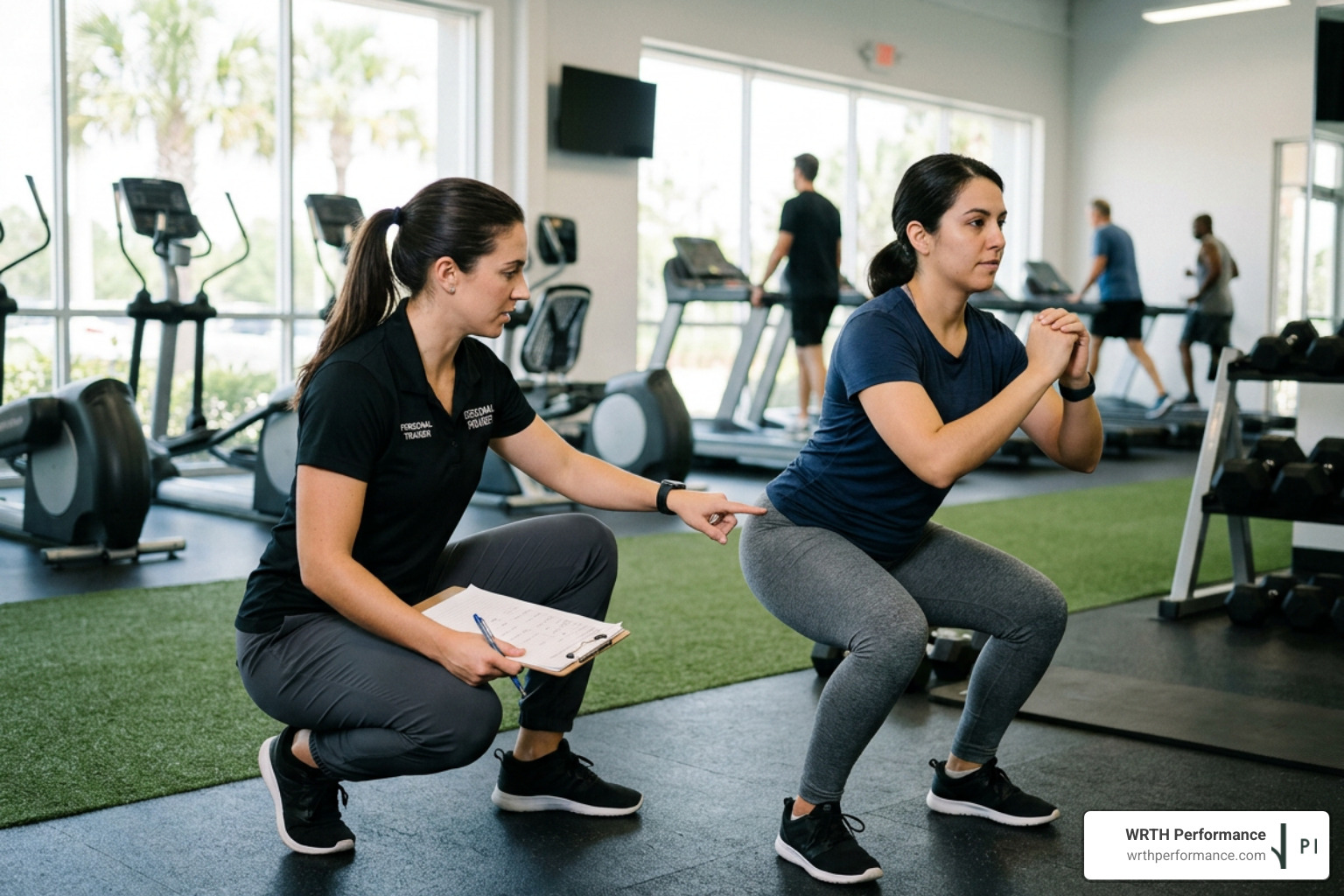
Second, check if the program is static or dynamic. A high-quality plan is never written in stone. It should actively adapt based on your progress, feedback, and recovery metrics. If a trainer or app hands you a 12-week program and never asks to adjust it based on your performance, you are following a generic template, not a personalized program.
Frequently Asked Questions about Custom Fitness Plans
How much does working with a personal trainer increase the success of reaching fitness goals?
Research published in the Journal of Sports Science & Medicine shows that working with a personal trainer can increase your success rate of reaching your fitness goals by more than 30%. This dramatic increase is due to customized program design, real-time form correction, and the consistent accountability that a dedicated coach provides.
How often should a personalized training program be updated?
Most personalized training programs should be adjusted every 4 to 8 weeks. This timeframe represents a typical training cycle or block. Updating the plan allows us to apply progressive overload, introduce exercise variety to prevent mental burnout, and adjust your training focus as your physical capacity improves.
Can beginners safely follow an AI-driven workout plan?
Yes, but only if the AI system has built-in sports science safety constraints and human oversight. Beginners lack the movement foundations to recognize when an AI-generated workout is too intense or biomechanically inappropriate. For the safest and most effective results, beginners should use hybrid platforms where a certified human coach reviews and approves all AI-generated workouts before they are performed.
Conclusion
At WRTH Performance, we believe that your training should be as unique as your biology. We are a luxury private membership gym located in the heart of Downtown Orlando, Florida. We specialize in performance and longevity, offering a state-of-the-art training environment tailored to a limited, exclusive clientele.
Our members enjoy access to premium, state-of-the-art strength equipment, personalized training programs, and comprehensive nutrition counseling. To optimize your recovery, our facility features a full suite of science-driven recovery modalities, including:
- Infrared sauna therapy
- Cold plunge therapy
- PEMF (pulsed electromagnetic field) therapy
- Red light therapy
Because we prioritize the quality of our training environment and individual member attention, our membership is intentionally capped. If you are ready to experience a truly personalized, scientific approach to your health and fitness, we invite you to take the next step at www.wrthperformance.
