

How Much Does a Gym Membership Really Cost Per Month?
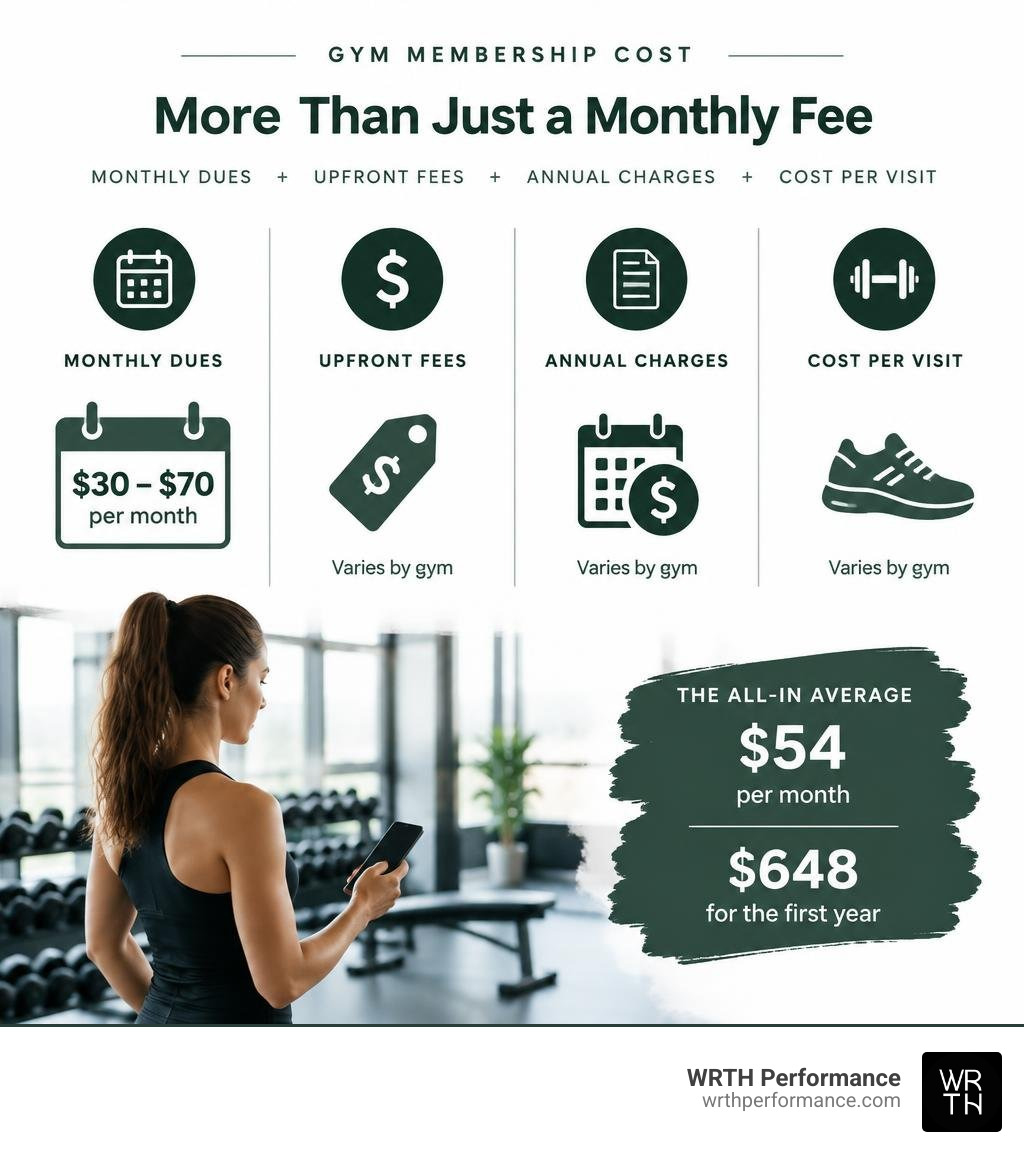
In 2026, most U.S. gym memberships cost about $30 to $70 per month. One pricing estimate puts the all-in average near $54 per month, or $648 for the first year. That estimate includes more than monthly dues, so it is not the price every gym will quote you.
To compare memberships fairly, add joining fees, annual charges, and any services you plan to use. A higher monthly rate may be better value if it includes the training or recovery you want.
With two decades of experience as an Orlando personal trainer, Jason Kasheta helps clients make informed strength, fitness, and nutrition decisions. This guide focuses on the amount you may actually spend beyond a gym’s advertised rate.
Related guides:
- What are the most exclusive, private membership gyms in Orlando that limit the number of members to ensure a premium experience?
- luxury health club
How much is the average gym membership per month?
There is no single answer, because sources measure different things. To estimate how much the average gym membership is per month, compare posted dues with fees, promotions, grandfathered rates, and employer discounts. That is why you will see averages anywhere from the low $40s to the high $60s for standard gym access.
Here is how the main numbers line up:
- 2026 all-in estimate: about $54 per month ($648 per year), with a median near $49. This spreads the joining fee across 12 months.
- 2024 posted dues: an industry consumer report put the average at $69 per month, up from $65 in 2023. The median was $38, up from $30. You can read more in this 2024 fitness membership and dues report.
- 2024 survey-based average: 2024 U.S. membership cost data shows a figure of about $40, up roughly $4 from the year before. Over the decade, that series climbed from about $29.
Why is the average ($69) so far above the median ($38)? A median is the middle price, so cheap gyms hold it down. An average gets pulled up by premium clubs and coached studios. Almost 67% of members paid under $50 per month on average, yet facilities charging $100 or more grew faster than the rest. A few big numbers make the average look higher than what most people pay.
How much is the average gym membership per month in 2026?
For most people, the realistic range looks like this:
- $30 to $70: the common range for a standard full-service gym.
- $10 to $25: budget access with basic equipment.
- $80 to $200+: premium access with more amenities, space, and service.
One analysis found that members usually pay 15% to 30% more than the listed rate once ancillary fees are added. So the $54 all-in figure sits sensibly between the cheapest posted rates and the $69 posted average. Use the median as your “what is normal” number and the average as your “what the market looks like” number.
How much is the average gym membership per month by gym tier?
The word “gym” covers very different products. Comparing a basic-equipment gym with a coached private facility is like comparing a food truck with a tasting menu. Both feed you but the experiences are dramatically different.
| Tier | Typical monthly price | What you usually get |
|---|---|---|
| Budget | $10 to $25 | Basic cardio and machines, limited free weights, self-directed workouts |
| Mid-range | $30 to $70 | Larger floor, group classes, sometimes pools or courts |
| Boutique studio | $100 to $250 | Small-group, coached classes with structure and community |
| Specialized (strength club, functional fitness) | $80 to $250 | Specialty equipment and coaching for a specific sport or goal |
| Premium and luxury | $120 to $300+ | Large facilities, spa-style extras, classes, staff service |
| Private membership | Varies by facility | Capped membership, personalized training, recovery services |
Budget gyms stay cheap by selling lots of memberships, focusing on cardio equipment that costs less to maintain, and skipping pools and saunas. Many members also visit rarely, which keeps floors manageable. Premium and private facilities go the other way: fewer members, more staff attention, more space.
How gym costs vary by city and region

Where you live matters a lot. One 2026 city comparison found averages from about $34 per month in Phoenix to about $89 in New York. That is a gap of roughly 160%, even though the income gap between those cities was only about 17%. The main driver is commercial rent, not paychecks. Add the number of competing gyms nearby, and you have the full picture. More competition pushes prices down, and fewer options push them up.
State-level estimates tell a similar story. One 2026 state analysis put the national average at $69, with California and Hawaii near $76 and Mississippi and Arkansas near $60. It put Florida at about $71, a little above the national figure.
Within Orlando, expect variation by neighborhood. Gyms in the Downtown core pay more for space than gyms in outlying suburbs, and amenities, class schedules, and capacity limits all shift the rate. We have not found a reliable Orlando-wide average, so get quotes from the specific facilities you are considering.
What factors and fees change the true gym membership cost?
A monthly rate is built from many pieces:
- Location and facility size: rent is the biggest cost for most gyms.
- Equipment: racks, plates, and cardio machines cost money to buy and maintain.
- Classes and staffing: instructors, coaches, and front-desk teams are real expenses.
- Access hours: staffed 24/7 operation costs more than limited hours.
- Coaching and amenities: the more built in, the higher the price.
- Contract length and billing schedule: month-to-month flexibility often costs a bit more than a long commitment.
Which services and amenities affect the price?
Think of amenities as a menu. Some items come with the base price, and others are billed separately.
- Strength and cardio equipment: nearly every gym has it, but quality, quantity, and crowding vary. Budget gyms may cap dumbbells around 60 to 75 pounds, and mid-range gyms may have only a few squat racks.
- Group classes, pools, and childcare: these raise the price but can replace several separate bills if your family uses them.
- Towel service and parking: towels can run $5 to $15 per month, and parking $10 to $30.
- Personal training: typical sessions run $40 to $120 depending on the gym type and trainer. Our guide to personal training rates and cost factors explains what drives those differences.
- Nutrition coaching: often an add-on, sometimes bundled at higher tiers.
- Recovery services: sauna, cold plunge, PEMF, and red light therapy are rarely included at budget or mid-range gyms. Standalone recovery sessions can add up quickly, so a facility that bundles them may change the math.
The question to ask is not “what is the cheapest gym?” but “which of these will I actually use?” Paying for a pool you never enter is like paying for a gym you never visit.
What hidden fees should you check before joining?
Advertised monthly rates often leave out the following:
- Initiation or enrollment fee: usually $25 to $99, sometimes up to $300 at upscale clubs.
- Annual maintenance fee: $39 to $59 at many chains, and up to $100 elsewhere. It often arrives a few months after you join, which surprises people.
- Key fob or locker rental.
- Class add-ons: $10 to $30 per month extra, or $5 to $25 per premium class.
- Freeze fee: $5 to $15 per month for pausing.
- Late-cancellation or no-show fees: often $10 to $30.
- Early termination fee: $50 to $200 on fixed-term contracts.
- Rate increase clause: the contract may allow price hikes, so read it.
To show how much this matters, one comparison looked at two memberships advertised at $24.99 per month. After a $99 initiation fee, a $49 annual fee, and a mandatory $19 monthly towel charge, one cost $605.76 in year one, versus $348.76 for the other. That is 74% more for the same headline price.
How to calculate the all-in first-year cost
This is the number we want you to remember. Use this simple formula in plain words: (monthly rate × 12) + initiation fee + annual fee + required add-ons + taxes. Divide the total by 12 to get your true monthly cost.
Here are some sample first-year totals. They are illustrations, not quotes from any gym:
| Example | Monthly rate | Fees | First-year total | Monthly equivalent |
|---|---|---|---|---|
| Budget | $15 | $49 annual | $229 | about $19 |
| Mid-range | $40 | $50 initiation, $49 annual | $579 | about $48 |
| Full-service | $70 | $100 joining fee | $940 | about $78 |
| Higher-end, no fees | $90 | None | $1,080 | $90 |
Notice the last two. A $70 gym with a $100 fee costs $940 in year one, and a $90 gym with no fees costs $1,080. The difference is $140 a year, or about $12 per month. If the pricier gym includes things you would otherwise pay for separately, it can easily be the better deal.
Also check taxes, whether the contract auto-renews, and how you cancel. Many states now require online cancellation if you signed up online, but confirm it in writing.
How to compare gym value and lower your costs
The cheapest gym you never visit is not a bargain. The better measure is cost per visit: total monthly cost divided by the number of visits.
Say a gym costs $50 per month all-in:
- 12 visits per month works out to about $4.17 per visit.
- 8 visits works out to about $6.25.
- 4 visits works out to $12.50.
The numbers behind real attendance are sobering. The average member visited a facility about 78 days in 2024, roughly 1.5 times per week, down from about 110 days in 2019. One study of members paying over $70 per month found they visited just 4.3 times monthly, which is over $17 per visit.
So be honest about your schedule. Location convenience, class times, equipment fit, and a trial pass all matter more than a $10 difference in dues. A gym that is on your route and has a rack open when you arrive will beat a cheaper one you skip.
How can you save money on a gym membership?
- Employer wellness benefits: ask HR about discounts or reimbursements. Corporate discounts commonly run 10% to 20%.
- Student, military, and group discounts: many gyms offer them, and some give 10% to 25% off.
- Seasonal promotions: January and Black Friday often bring waived fees, though slow months like May, June, October, and November can also be good times to negotiate.
- Referral offers: a friend’s referral can waive your joining fee.
- Waived initiation fee: the easiest single win.
- Off-peak access: cheaper tiers sometimes limit you to quieter hours.
- Annual prepayment: worth it only if the discount is around 10% or more and you are confident you will stay.
- Membership freeze: useful for illness, pregnancy, or long travel, but check the freeze fee first.
Can you negotiate gym membership fees?
Often, yes. Initiation fees cost a gym very little to waive, so they are the most flexible line item. One source estimated success at roughly 50% to 60% at commercial chains. Try these steps:
- Ask directly, “Can you waive the initiation fee?” If the rep says no, ask for a manager.
- Compare local offers and mention a competitor’s current price.
- Request a promotion you saw online earlier.
- Ask about a group rate if you join with family or friends.
- Confirm what prepaying saves and what happens if you cancel early.
Timing helps. Slower months and the last week of a month often work in your favor.
Does health insurance cover gym memberships?
Sometimes, but not by default. Here is what to check:
- Plan-specific fitness benefits: some plans include discounts or reimbursement. Look in your plan handbook or member portal.
- Employer reimbursement: some programs return about $20 to $40 per month.
- Medicare Advantage fitness programs: Original Medicare does not cover gym memberships, but many Medicare Advantage plans and some supplemental plans offer free or low-cost fitness programs at participating locations.
- HSA or FSA funds: these generally need documentation from a licensed health professional tying exercise to a specific condition. Ask your plan administrator what they require.
Always verify reimbursement limits and eligibility before you enroll, not after.
What should you check before signing up?
Run through this list on your trial visit:
- The total first-year price, not just the monthly rate
- Included amenities and the ones that cost extra
- Hours, and whether full services are available when you train
- Peak-time crowding and equipment condition
- Trial period or day pass options
- Contract commitment and auto-renewal
- Cancellation process and pause policy
For a deeper look at weighing options, our guide to comparing fitness membership options walks through what separates one tier from the next.
Frequently asked questions about gym membership costs
Can you pay annually instead of monthly?
Yes. Many gyms offer prepaid annual plans, often 10% to 15% cheaper than paying monthly. The tradeoff is the upfront commitment. Ask about refund terms and early cancellation before paying. If you are a first-time member, month-to-month for the first six months is usually the safer bet, since nearly half of new members quit within that window.
Is a gym membership worth it if I only go once or twice a week?
It can be, but run the numbers. At $50 per month and 6 visits, you pay about $8.33 per visit. If a drop-in rate is $10 to $20 per session, the membership still wins, but only just. If a commute eats an hour each way, factor that in too. Included services such as classes or recovery can tip the balance. If you would rather not commit, a pay-per-visit or class-pack model may suit you better.
What is a reasonable monthly budget for a gym?
Start with your goals. General fitness works well at a budget or mid-range gym. Serious strength training may call for a gym with multiple racks and a full dumbbell range, often $40 to $150 per month depending on the facility. If you want personal training, nutrition guidance, or recovery, a higher tier makes sense. Then check your household budget, pick a tier, and compare first-year totals. A good rule is to spend what you will realistically use.
Conclusion
The advertised price is only the start. Compare the total first-year cost, choose amenities you will actually use, and divide by your real number of visits. Most people land between $30 and $70 per month, but fees, location, and tier can move that number a lot.
If you want something different from a high-volume gym, we built WRTH Performance as a private membership gym in Downtown Orlando. Our membership is intentionally capped, so you get state-of-the-art equipment, personalized training, nutrition counseling, and science-driven recovery with sauna, cold plunge, PEMF, and red light therapy, all focused on performance and longevity. See our membership pricing and options to find out whether it fits your goals. Because space is limited, availability is limited too.
