

Build a Longevity Training Program You Can Keep
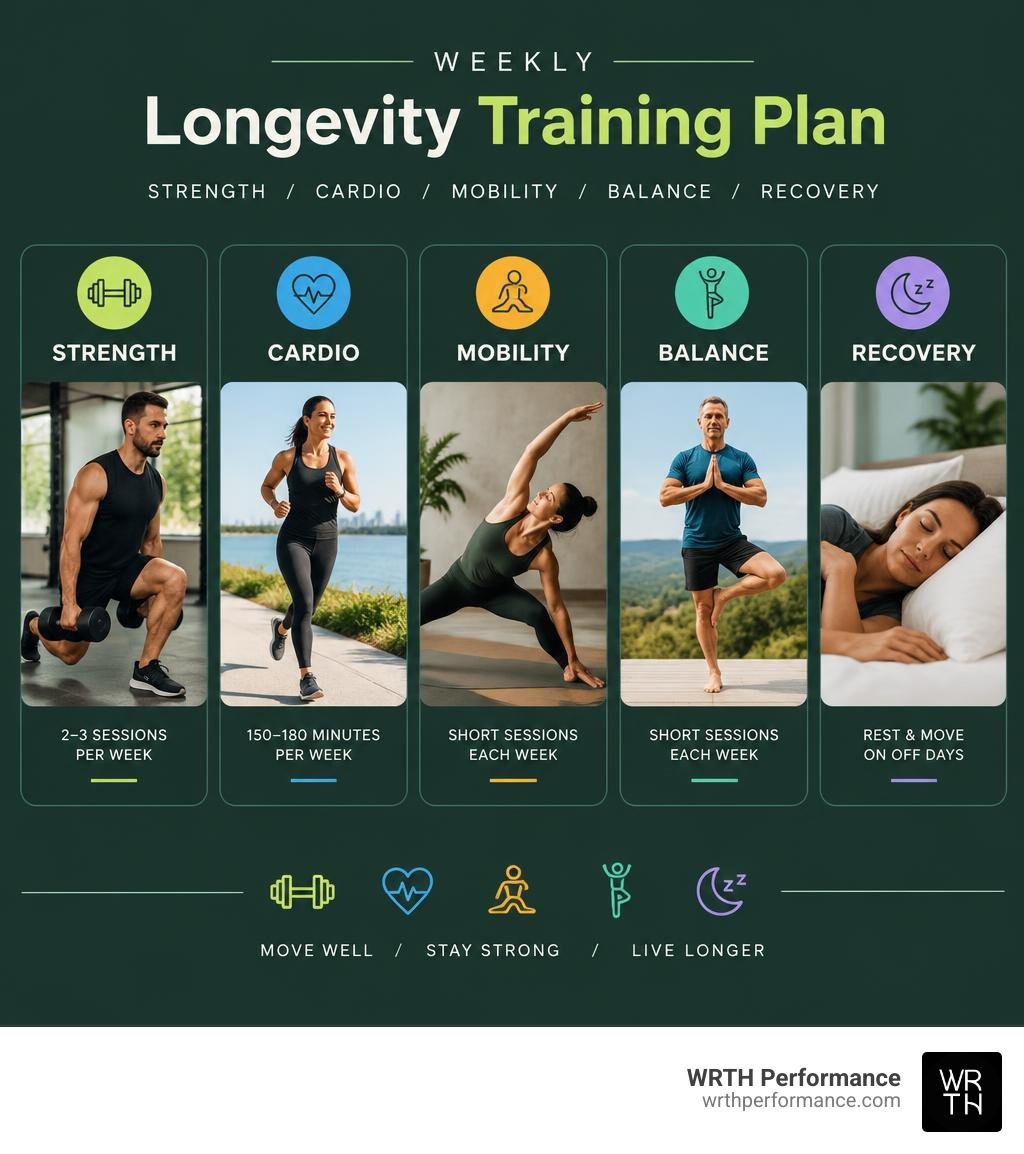
A longevity training program should help you stay strong, fit, and able to move well for decades. Start with two to three strength sessions each week, build toward cardio at a pace where you can still talk, and add short mobility and balance sessions. Make room for rest and keep moving on days you do not train.
A new personal record can be rewarding. But if chasing one leaves you hurt or too worn out to train, it works against the bigger goal: more years of doing what you love.
I’m Jason Kasheta, owner of WRTH Performance in Downtown Orlando. I’ve spent 20 years coaching strength, fitness, and nutrition, and I bring that experience to building a longevity training program that fits real life.
Introduction
Most fitness culture celebrates the immediate – the heaviest deadlift, the sweatiest burnout session, or dropping ten pounds in two weeks. While hitting a new personal record feels fantastic, training solely for short-term ego metrics often comes at the expense of joint health, connective tissue durability, and systemic recovery.
True physical longevity shifts the conversation from lifespan (the total years you live) to healthspan (the period of life spent in vibrant physical and cognitive health). When we sacrifice joint integrity or tax our central nervous system chasing an arbitrary number on a barbell, we gamble with our future independence. A sustainable routine builds structural durability, improves mitochondrial density, and ensures your body remains functional in your 70s, 80s, and beyond.
The Core Pillars of a Complete Longevity Training Program

A comprehensive physical strategy requires more than one-dimensional workouts. Embracing longevity as the new performance standard means balancing multiple physical adaptations rather than over-indexing on just lifting or just running.
Research into lifelong health, including frameworks explored in The Longevity Program research, shows that peak physical preservation rests on four foundational pillars:
- Cardiovascular Aerobic Capacity: Building a massive aerobic base that sustains cellular health.
- Neuromuscular Strength & Power: Maintaining contractile muscle tissue and strong bones.
- Mobility, Balance, & Motor Control: Keeping joints supple and preventing debilitating falls.
- Restoration & Recovery: Giving tissues time to adapt and clear metabolic waste.
Aerobic Efficiency: Zone 2 Cardio and Avoiding the Black Hole Zone
Aerobic base building centers on Zone 2 cardio: moderate, steady-state movement performed at an intensity where you can comfortably speak in full sentences without gasping. The target volume is between 150 and 180 minutes of cardio per week.
This low-intensity work spurs mitochondrial biogenesis (the creation of new cellular powerhouses) and increases the clearance rate of blood lactate. It also protects your immune function. Physical exertion follows a J-shaped curve: moderate exercise reduces upper respiratory tract infection risk by 40% to 50% compared to a sedentary lifestyle, whereas frequent, heavy, redline exertion increases illness risk two- to six-fold.
Many recreational athletes fall into the “Black Hole” training trap: working at a pace that is too intense to be true Zone 2, but not intense enough to drive true peak anaerobic power. Lingering constantly in this middle zone drives up chronic cortisol, drains systemic energy, and increases wear and tear without delivering optimal aerobic or metabolic adaptations.
Preserving Type II Fibers: Strength and the Power-to-Mass Ratio
Aging muscles naturally experience sarcopenia, an age-related loss of muscle mass and quality. After age 40, lean mass and strength drop by roughly 2% per decade, while fat mass increases by about 7.5%. After age 50, strength loss accelerates beyond 15% per decade.
This decline disproportionately strikes Type II (fast-twitch) muscle fibers, which govern power, rapid stabilization, and quick force production. Older adults who strength train at least twice weekly show a 46% lower risk of all-cause mortality, a 41% lower risk of cardiac mortality, and a 19% lower risk of cancer mortality compared to those who do not lift.
When training for long-term health, prioritize myofibrillar hypertrophy (increasing actual dense muscle fiber proteins for pure force production and high power-to-mass ratio) over sarcoplasmic hypertrophy (fluid accumulation within the muscle cells often pursued in standard bodybuilding).
| Feature | Myofibrillar Hypertrophy | Sarcoplasmic Hypertrophy |
|---|---|---|
| Primary Mechanism | Increase in contractile protein strands (actin & myosin) | Increase in sarcoplasmic fluid, glycogen, and cellular volume |
| Functional Outcome | Dense, strong muscle with a high power-to-weight ratio | Larger visual muscle bellies with moderate relative force |
| Rep & Load Range | Heavier loads (5–10 reps), multi-joint compound lifts | Moderate-to-light loads (10–20+ reps), shorter rest intervals |
| Longevity Benefit | Preserves fast-twitch motor units and joint stability | Promotes local blood flow and glycogen storage |
Focusing on compound movements – squats, hinges, presses, rows, and carries – develops usable, functional strength without adding excess, non-functional mass that stresses joints.
Joint Integrity, Dynamic Mobility, and Balance
Muscles only produce force safely if the surrounding connective tissues, ligaments, and articular cartilage remain healthy. Incorporating science-backed mobility guidelines into your regular schedule combats tissue stiffening and safeguards full ranges of motion.
Single-leg stability drills, such as Bulgarian split squats, step-downs, and single-leg balance holds, train proprioception and neuromuscular coordination. Falls represent one of the greatest threats to independence later in life; maintaining balance and dynamic ankle, knee, and hip stability drastically cuts that risk. Integrating targeted breathwork into mobility routines helps downregulate the sympathetic nervous system and enhances postural control.
Essential Biomarkers: Measuring Real Longevity Beyond the Scoreboard
Instead of evaluating your fitness solely by how much weight is loaded on a barbell or how small your waistline is, track objective functional markers that correlate with vitality and biological youth.
Grip Strength and Lower-Body Power as Mortality Predictors
Grip strength is a powerful window into overall neuromuscular vitality. In large-scale research spanning 17 countries and over 140,000 individuals, each 5-kilogram drop in grip strength was linked to a 16% increase in all-cause mortality, proving to be a stronger predictor of mortality than systolic blood pressure.
Pairing dynamometer grip tests with functional carrying drills – such as loaded farmer’s carries – builds practical hand, wrist, and core resilience. Alongside grip tests, evaluating lower-body power (such as a 5-rep sit-to-stand speed or vertical jump power) provides insight into your posterior chain and quad strength, which are essential for navigating stairs and preventing stumbles. Incorporating structured personalized training strategies ensures these specific physical capabilities are consistently challenged and developed.
VO2 Max and Cellular Rejuvenation
Cardiorespiratory fitness, measured as VO2 max, is another premier longevity metric. While VO2 max can drop by up to 15% per decade after age 50 in inactive populations, lifelong cardiorespiratory training can slow this decline so significantly that an active 80-year-old can match the aerobic capacity of a sedentary 35-year-old.
At the cellular level, long-term endurance training helps preserve leukocyte telomere length – providing an estimated 10-year biological age advantage. Furthermore, six months of endurance training has been shown to reverse roughly 40 years of mitochondrial gene expression changes in older adults, rejuvenating cellular energy systems from the inside out.
Structuring the Weekly Routine: Volume, Intensity, and Decadal Progression
An optimal weekly schedule balances heavy resistance, low-intensity aerobic base building, targeted power work, and restorative recovery. Exploring comprehensive wellness pathways can help you organize these distinct physical stimuli smoothly across the week.
Here is a balanced weekly template designed for long-term health:
- Monday: Upper Body Strength (5–10 rep range) + 10 minutes core and grip carries
- Tuesday: 45–60 minutes Zone 2 Cardio (conversational pace)
- Wednesday: Lower Body Strength & Power (5–10 rep range) + Single-Leg Balance
- Thursday: 45–60 minutes Zone 2 Cardio + Active Mobility & Breathwork
- Friday: Full Body Strength & Muscular Endurance (11–25 rep range or bodyweight)
- Saturday: 45 minutes Zone 2 Cardio or Low-Impact Outdoor Movement + Brief High-Intensity Sprints (e.g., 4 x 30-second hard efforts on a bike)
- Sunday: Dedicated Rest and Recovery (Gentle walking, sauna, cold plunge)
Managing Concurrent Interference in a Longevity Training Program
When you combine heavy lifting with endurance training, your body manages two distinct cellular signals:
- mTOR Pathway: Stimulated by mechanical tension and resistance training, promoting muscle protein synthesis.
- AMPK Pathway: Stimulated by endurance exercise, promoting mitochondrial development and energy efficiency.
When triggered simultaneously in the same training session, AMPK can blunt mTOR signaling, dampening strength adaptations. To minimize this concurrent interference effect, separate your dedicated strength sessions and longer cardio sessions by at least 6 to 8 hours, or place them on alternate days. If you must perform both in one workout, complete your strength work first and follow with your aerobic training.
Age-Specific Adjustments for Your Longevity Training Program
Your physical framework should evolve gracefully across the decades:
- 20s & 30s: Focus on establishing clean movement patterns, maximizing bone mineral density, and building robust structural strength with higher training volumes.
- 40s & 50s: Prioritize joint conservation, manage recovery demands, ensure strict execution tempo, and protect against the accelerating loss of fast-twitch muscle fibers.
- 60s and Beyond: Shift emphasis toward explosive power retention (using lighter weights moved quickly), single-leg balance, fall prevention, and blood flow preservation, keeping reps clean and well clear of technical failure.
Advanced Modalities and Nutritional Support for Sustained Healthspan
Training provides the stimulus; adaptation happens during recovery. Pair your workouts with targeted nutrition and evidence-based wellness modalities, using advanced performance solutions to accelerate soft-tissue repair and metabolic recovery.
Protein Optimization and the Leucine Trigger
As we grow older, our bodies experience anabolic resistance, meaning muscles require a stronger amino acid signal to stimulate muscle protein synthesis (MPS). To overcome this, consume between 1.6 and 2.2 grams of high-quality protein per kilogram of body weight daily, distributed across 3 to 4 meals.
Each meal should supply at least 2.5 to 3.5 grams of the essential amino acid leucine. Leucine acts as the primary biochemical trigger that turns on the mTOR pathway, ensuring your body utilizes dietary amino acids to rebuild and protect lean tissue.
Joint-Friendly Stimuli: Blood Flow Restriction and Recovery Technology
Blood Flow Restriction (BFR) training involves placing specialized pneumatic cuffs on the upper limbs to safely restrict venous blood return while maintaining arterial inflow. By lifting very light loads (20% to 30% of your 1-rep max) under occlusion, metabolic stress builds rapidly within the muscle, producing muscular adaptations comparable to heavy lifting without putting excess mechanical strain on joints. This makes BFR a valuable tool for cross-training or de-loaded training cycles.
In addition to intelligent exercise modifications, science-driven recovery technologies support deep cellular rejuvenation:
- Infrared Sauna Therapy: Induces heat shock protein activation, improves endothelial function, and supports cardiovascular efficiency.
- Cold Plunge Immersion: Modulates systemic inflammation, enhances autonomic nervous system tone, and promotes mental resilience.
- PEMF & Red Light Therapy: Stimulates mitochondrial cytochrome c oxidase activity and supports localized microcirculation in stressed tissues.
Frequently Asked Questions About Longevity Training
How does longevity training differ from aesthetic bodybuilding?
Aesthetic bodybuilding focuses primarily on visual symmetry, maximizing cellular muscle swelling (sarcoplasmic hypertrophy), and reducing body fat to extreme levels that can impair hormonal health. Longevity training prioritizes dense contractile strength (myofibrillar hypertrophy), cardiovascular and mitochondrial function, joint integrity, dynamic balance, and systemic recovery to keep you capable for life.
What is the most effective way to test if you are in Zone 2 cardio?
The simplest, most reliable field test is the “talk test.” You should be able to maintain a conversation in complete, comfortable sentences without gasping for breath, while breathing primarily through your nose. If you can only speak in short, broken phrases, you have drifted into Zone 3 or the Black Hole zone and need to ease your pace.
Why is power development prioritized over pure muscle mass as you age?
Muscle power (the ability to generate force quickly) declines roughly twice as fast as pure isometric muscle strength. Power is what allows you to rapidly catch yourself from a trip, step quickly over an obstacle, or react to dynamic environments. Retaining fast-twitch motor unit recruitment is critical for everyday mobility and fall prevention.
Conclusion: Build a Body That Serves You for the Next 30 Years
Prioritizing short-term vanity numbers over durable vitality is a quick path to burnout and joint wear. Sustainable longevity relies on small, consistent habits: steady Zone 2 cardio, compound lifts that preserve fast-twitch fibers, daily mobility routines, and proactive recovery.
Training with precision and expert guidance makes all the difference in crafting a lifelong routine. At WRTH Performance in Downtown Orlando, we provide an intentionally capped, private training environment equipped with advanced recovery modalities – including infrared sauna, cold plunge, PEMF, and red light therapy – and personalized coaching designed to support your healthspan. To start training for decades of high-level performance, explore private boutique memberships and build a foundation that serves you for life.
