

PEMF Therapy Chronic Pain Treatment: A Simple, Evidence-Aware Overview
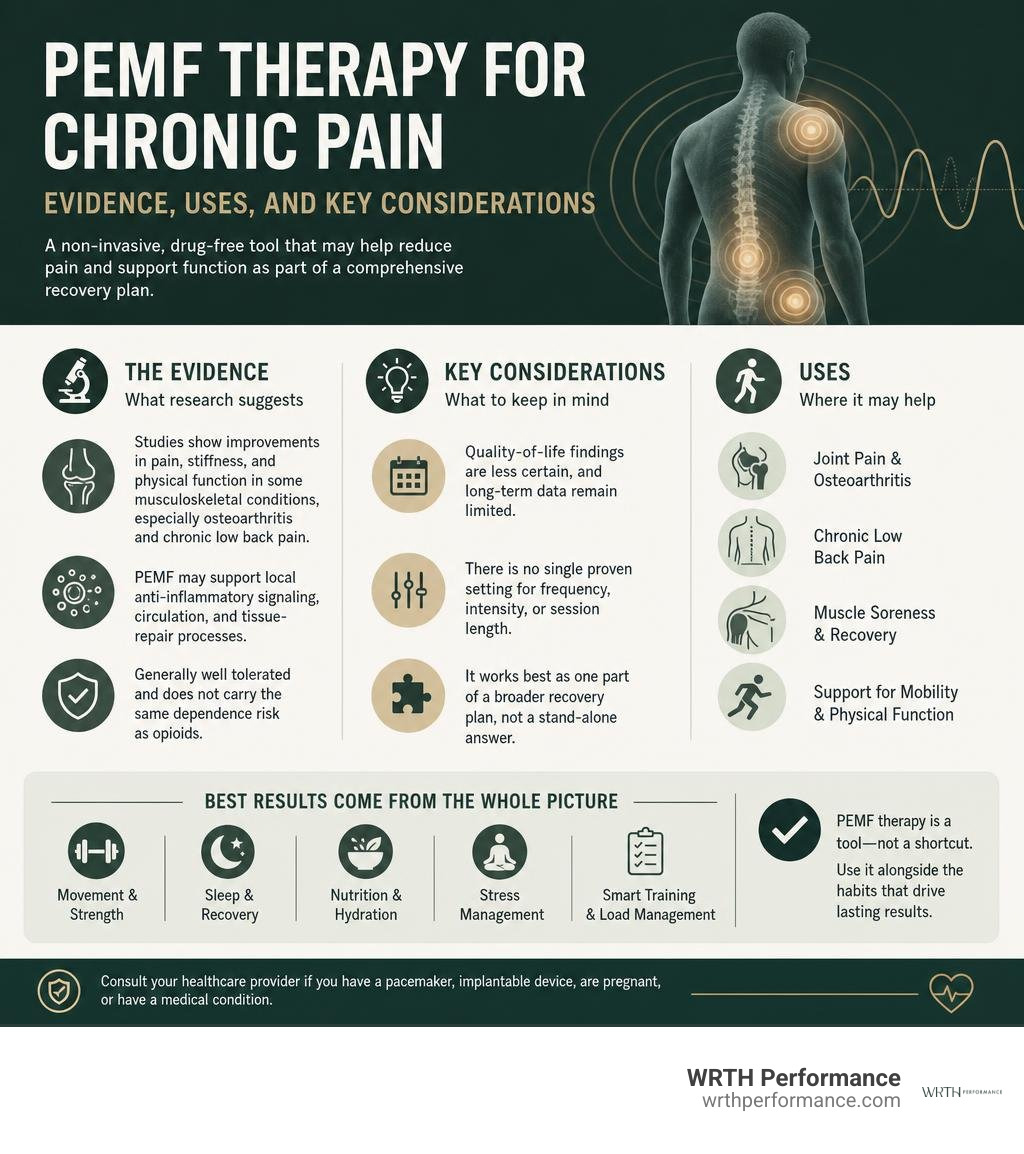
PEMF therapy chronic pain treatment uses low-level pulsed electromagnetic fields as a non-invasive recovery tool for persistent joint, muscle, and back discomfort. Research suggests PEMF may help reduce pain and stiffness and support physical function in some musculoskeletal conditions, especially osteoarthritis and chronic low back pain, but results vary by condition, device, and protocol.
| What the research suggests | What to keep in mind |
|---|---|
| Osteoarthritis trials show improvements in pain, stiffness, and physical function compared with sham treatment. | Quality-of-life findings are less certain, and long-term data is still being collected. |
| PEMF may support local anti-inflammatory signaling, circulation, and tissue-repair processes. | Research continues on the best frequency, intensity, or session length. |
| It is generally well tolerated and does not carry the same dependence risk as opioids. | It works best as one part of a broader recovery plan, not a stand-alone answer. |
For people balancing demanding training, work, and recovery, the appeal is clear: a session is passive, drug-free, and designed to fit alongside movement, strength work, sleep, nutrition, and other recovery habits. Still, PEMF is not a shortcut or a replacement for addressing the training load, mobility limits, or lifestyle factors that may be keeping pain active.
I am Jason Kasheta, an Orlando-based personal trainer with 20 years of experience in exercise science, nutrition, strength training, and performance-focused recovery. At WRTH Performance, a private fitness, training, recovery, and wellness facility, I help members evaluate tools such as PEMF therapy chronic pain treatment in the context of sustainable training and long-term performance.
Step 1: Restoring Biological Signals and Cellular Energy
At its core, PEMF therapy chronic pain treatment works by applying low-frequency electromagnetic pulses to tissues experiencing persistent stress, fatigue, or soreness. Every cell in the human body relies on tiny electrical charges across its membrane to move nutrients, expel metabolic waste, and produce cellular energy in the form of adenosine triphosphate (ATP).
When muscles, tendons, or joints remain chronically inflamed or overworked, these cellular electrical potential balances become disrupted. Tissues essentially lose their charge, leading to reduced oxygenation, sluggish microcirculation, and accumulation of metabolic byproducts that trigger local pain receptors.
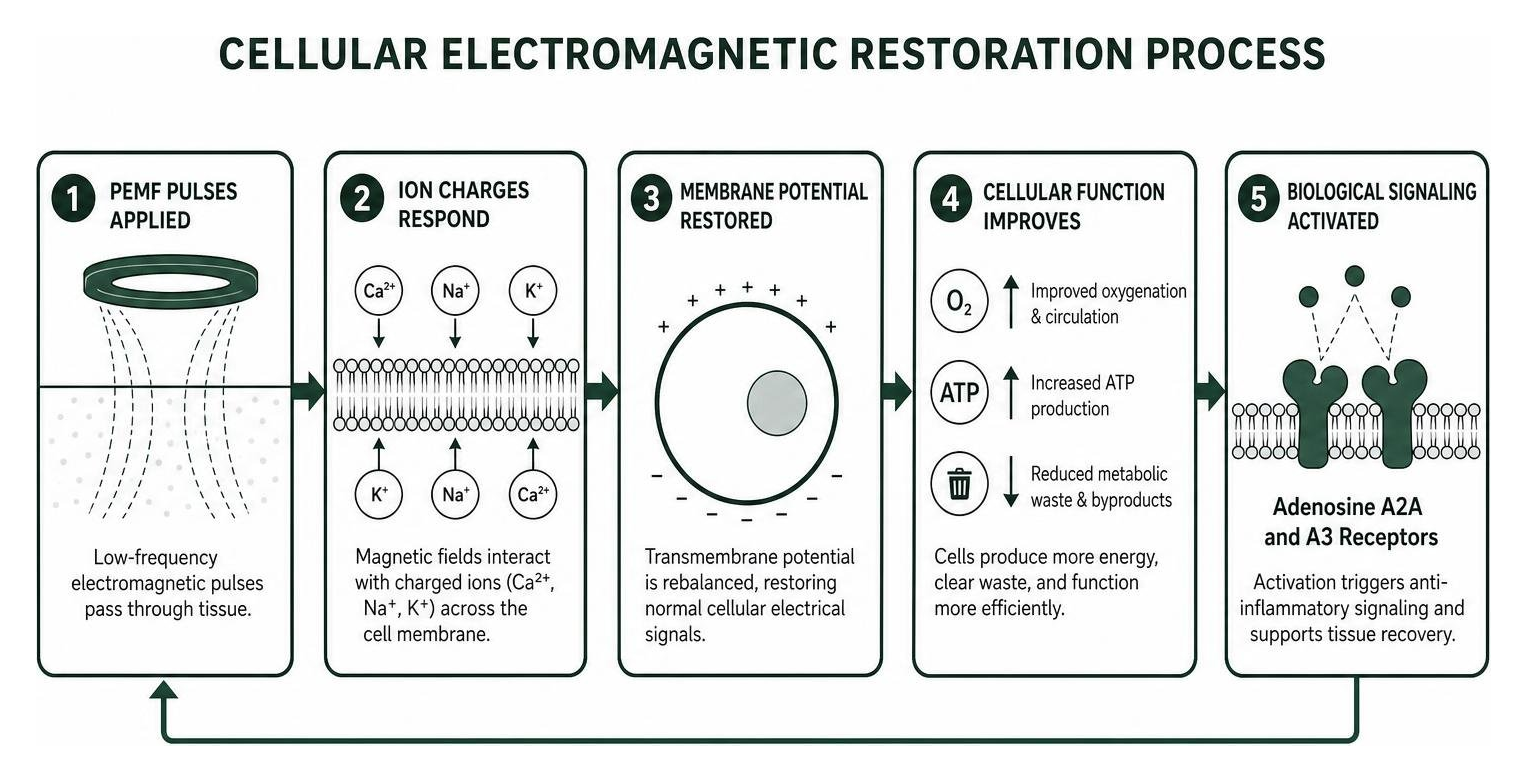
PEMF exposure introduces gentle magnetic pulses that pass effortlessly through soft tissue, skin, and bone. These magnetic waves interact with charged ions (such as calcium, sodium, and potassium) inside and outside the cell.
By restoring the transmembrane potential, PEMF acts like a natural recharge for fatigued cells. This electromagnetic restoration triggers key biological signaling events:
- Adenosine A2A and A3 Receptor Activation: PEMF stimulation acts as an agonist on specific adenosine cell surface receptors. This binding triggers an anti-inflammatory cascade that quiets hyperactive inflammatory signaling pathways.
- Calcium-Calmodulin Binding: The pulses accelerate the binding of calcium ions to calmodulin, a crucial regulatory protein inside human cells.
- Endothelial Nitric Oxide Synthase (eNOS) Activation: Calmodulin activation stimulates eNOS to release controlled, natural bursts of nitric oxide (NO).
- Microcirculation Enhancement: Nitric oxide causes local blood vessels and lymphatic channels to dilate, surging fresh oxygenated blood to target tissues while accelerating the removal of cellular waste and fluid build-up.
For more details on research evaluating how these pulse dynamics function across different field strengths, see this scientific evidence on magnetic field therapies.
Cellular Mechanisms in PEMF Therapy Chronic Pain Treatment
Understanding the molecular cascade helps explain why non-invasive magnetic stimulation offers targeted relief without reliance on oral pain relievers. When biological signals are re-established, downstream chemical pathways adjust rapidly:
- Downregulation of Pro-Inflammatory Cytokines: Studies demonstrate that low-frequency fields downregulate key signaling molecules like interleukin-1 beta (IL-1β), interleukin-6 (IL-6), and interleukin-8 (IL-8), which are responsible for persistent joint and soft tissue swelling.
- COX-2 Downregulation Without Systemic Risks: PEMF therapy reduces cyclooxygenase-2 (COX-2) enzymatic activity locally. Traditional non-steroidal anti-inflammatory drugs (NSAIDs) block COX-2 systemically, which carries well-documented risks of gastrointestinal distress, kidney stress, or cardiovascular strain. Targeted pulsed fields deliver similar localized anti-inflammatory signaling without systemic side effects.
- Enhanced Tissue Oxygenation: By expanding capillary flow, damaged tendons, ligaments, and muscle fibers receive an influx of oxygen and essential amino acids required for cellular repair.
To explore how these cellular mechanisms support daily athletic recovery and muscle rejuvenation, review our practical guide to electromagnetic benefits.
Step 2: Calming Inflammatory Pathways and Soothing Sore Nerves
The second step in how PEMF therapy chronic pain treatment works involves modulating neural signaling and calming overstimulated nerve fibers. Chronic joint and soft tissue discomfort is rarely limited to physical swelling; it also involves altered pain perception in the peripheral and central nervous systems.
When tissues remain irritated over weeks or months, peripheral nerves lower their activation thresholds, firing pain signals even in response to normal everyday movement. Over time, this constant sensory stream can cause central sensitization, where the central nervous system becomes hyper-reactive.
PEMF therapy addresses both localized tissue swelling and nerve sensitivity through multiple complementary pathways:
- Local Signal Interruption: By clearing inflammatory proteins and stabilizing cell membranes around nerve endings, PEMF raises the threshold required for local nociceptors (pain-sensing nerves) to fire.
- Endogenous Opioid Release: Research suggests that low-frequency electromagnetic fields can stimulate the central nervous system to release natural endorphins and enkephalins – the body’s built-in pain-relief neuropeptides.
- Drug-Free Discomfort Relief: Because the magnetic waves modulate biological signaling naturally, users experience a softening of sharp or aching sensations without developing chemical tolerance or drug dependence.
Central vs Localized PEMF Therapy Chronic Pain Treatment
Not all chronic discomfort behaves the same way, and clinical research highlights a distinct difference in how PEMF impacts localized joint issues versus central pain conditions like fibromyalgia.
| Condition Type | Dominant Mechanism | Expected PEMF Mechanism | Clinical Research Findings |
|---|---|---|---|
| Localized Musculoskeletal Pain (e.g., Knee Osteoarthritis, Tendinitis, Low Back Strain) | Local mechanical stress, joint wear, elevated local COX-2 and IL-1β | Direct microcirculation boost, targeted COX-2 downregulation, improved tissue oxygenation | Multi-center trials show up to a 36% reduction in localized joint pain scores and a 55% reduction in daily pain medication reliance. |
| Central Pain Sensitivity (e.g., Fibromyalgia, Widespread Neuropathic Pain) | Central sensitization, altered brain limbic signaling, lowered pain thresholds | Cranial or full-body pulse exposure modulating limbic cell activity and triggering central neuropeptide release | Double-blind trials show fibromyalgia cohorts achieve clinically meaningful pain drops (e.g., 2.8 cm drop on a 14 cm scale) compared to sham controls. |
In localized joint conditions, such as knee or hip osteoarthritis, systematic reviews show a standardized mean difference (SMD) of 1.06 for pain reduction compared to placebo, alongside notable improvements in joint stiffness (SMD = 0.37) and daily physical function (SMD = 0.46).
For detailed clinical data regarding joint and soft tissue trial outcomes, read this clinical trial on joint pain management.
Step 3: Sustaining Long-Term Relief with Optimal Protocols for PEMF Therapy Chronic Pain Treatment
The third step focuses on protocol consistency and parameter calibration. A single application of electromagnetic waves can deliver short-term microvascular dilation and localized soothing, but lasting functional improvements require a cumulative approach over several weeks.
Just as a single workout will not build long-term strength, cellular restoration relies on repetitive, structured signals to shift long-standing inflammatory patterns into active tissue repair.
Optimal parameters widely studied in human trials include:
- Frequency Calibration: Most physical recovery protocols utilize low frequencies ranging between 1 Hz and 200 Hz (with many targeting 1–50 Hz to match human brainwave and biological movement frequencies).
- Magnetic Flux Intensity: Field strengths typically range from microtesla (μT) levels up to low millitesla (0.1 mT to 30 mT) levels for non-contractile cellular stimulation.
- Session Duration: Applications usually run between 10 and 60 minutes per session, depending on device design, target tissue depth, and individual recovery goals.
- Protocol Consistency: Comparative clinical studies on chronic low back pain demonstrate that running 15 structured sessions across a 3-week block yields significant reductions in pain and functional disability that persist through 12 weeks of post-treatment follow-up.
For further scientific reading on multi-week back discomfort protocols and long-term functional tracking, explore this comparative research on back pain recovery.
Integrating PEMF into a Complete Wellness Strategy
While PEMF therapy chronic pain treatment delivers remarkable cellular-level benefits, we view it at WRTH Performance as one powerful element within a complete lifestyle and performance strategy. Lasting joint health, tissue resilience, and movement freedom require an integrated environment where passive recovery tools amplify active movement and lifestyle habits:
- Synergy with Progressive Exercise: Combining regular low-frequency magnetic sessions with structured strength training, mobility work, and core stabilization produces far greater improvements in physical movement than passive recovery alone.
- Contrast and Thermal Modalities: Pairing PEMF sessions with Infrared Sauna Therapy encourages deep thermal microvascular expansion, while using Cold Plunge Therapy helps reset nervous system tone and manage acute post-training inflammation.
- Advanced Recovery Hubs: Utilizing high-grade pulsed mats or localized applicators within a dedicated facility allows busy individuals to combine cellular recovery, stress reduction, and athletic conditioning under one roof. Learn more in our guide to An Essential Guide to Gym Recovery Equipment.
Frequently Asked Questions About PEMF Therapy
Is PEMF therapy safe and supported by clinical evidence?
Yes, low-frequency pulsed electromagnetic field therapy is supported by decades of peer-reviewed research and randomized controlled trials. Non-ionizing, non-thermal low-frequency fields carry an exceptional safety profile with high user compliance and zero reported serious adverse events across high-quality clinical literature.
Standardized meta-analyses demonstrate clear, statistically significant advantages over placebo/sham devices for reducing joint discomfort and improving stiffness. Because it is completely non-pharmacological, it carries no risk of chemical dependency or gastrointestinal irritation.
For a comprehensive review of randomized placebo-controlled trials analyzing osteoarthritis outcomes, refer to this a systematic review on osteoarthritis outcomes.
How many sessions are needed to feel cumulative results?
While some individuals report a noticeable reduction in acute joint tightness or improved relaxation after their initial 15- to 30-minute session, cumulative structural and signaling benefits build over time.
Clinical research programs typically prescribe 3 to 5 sessions per week over a period of 3 to 4 weeks (10 to 20 total sessions), while 1-2 sessions per week may be ideal for users seeking recovery support.
Conclusion
Navigating persistent joint stiffness, back discomfort, or slow training recovery does not require choosing between invasive measures or living with restricted movement. PEMF therapy chronic pain treatment offers a clear, science-backed mechanism for restoring cellular electrical balance, lowering localized inflammatory markers, and enhancing blood flow to struggling tissues.
By restoring biological signals, calming irritated nerve pathways, and committing to consistent recovery protocols, you create an internal environment built for cellular rejuvenation and sustained physical performance. When integrated alongside intelligent strength training, personalized nutrition, thermal recovery, and proper sleep habits, non-invasive electromagnetic recovery helps you move better, recover faster, and protect your long-term vitality.
Ready to experience science-driven recovery in an exclusive, private environment? Discover PEMF and Red Light Recovery at WRTH Performance and elevate your training, recovery, and longevity goals in Downtown Orlando.
